

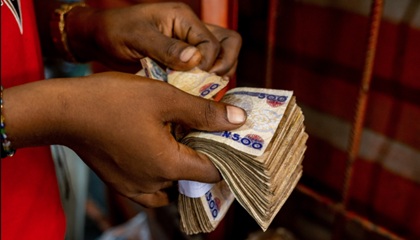
Former National Coordinator of the National Poverty Eradication Programme, Professor Magnus Kpakol, has urged the Federal Government to move beyond cash-transfer programmes and focus on building sustainable sources of income for Nigerians.
Kpakol warned that while direct financial assistance can provide temporary relief to vulnerable households, cash transfers alone cannot permanently lift people out of poverty.
He made the remarks during an interview with ARISE NEWS on Friday, where he argued that the success of poverty-reduction programmes should ultimately be measured by whether beneficiaries can become economically independent.
According to the former NAPEP boss, government interventions should be designed to help vulnerable Nigerians transition from dependence on welfare to productive economic activity.
He stressed the importance of creating opportunities that enable people to generate regular and sustainable incomes rather than relying indefinitely on government assistance.
The comments come amid renewed debate over the Federal Government’s social-protection programmes and its use of cash transfers to cushion the effects of rising living costs.
Cash transfers have become an important component of Nigeria’s efforts to support vulnerable households, particularly amid economic pressures that have increased the cost of food, transportation and other essential goods.
However, Kpakol’s intervention raises a fundamental question about the long-term effectiveness of welfare programmes: whether government should primarily provide temporary relief or invest more aggressively in helping citizens build productive capacity.
For millions of Nigerians facing economic hardship, immediate financial assistance can provide an important lifeline.
Cash can help households meet basic needs, purchase food, pay for transportation and keep children in school. But when such support ends, families without a reliable source of income can quickly return to financial vulnerability.
This is the gap Kpakol wants government policy to address.
Rather than concentrating solely on distributing money, he advocated policies that increase people’s ability to earn.
Such measures could include skills development, access to affordable finance, support for small businesses, agricultural productivity, infrastructure development and the creation of jobs in sectors capable of absorbing Nigeria’s growing labour force.
The former NAPEP coordinator’s argument also highlights the distinction between poverty relief and poverty eradication.
Relief programmes are designed to reduce immediate suffering, while poverty eradication requires structural changes that enable individuals and communities to build wealth and sustain themselves.
Nigeria’s challenge is particularly significant because of its large and rapidly growing population.
A sustainable poverty-reduction strategy must therefore create economic opportunities on a scale capable of reaching millions of people.
Small businesses and informal enterprises could play an important role in this process, given their contribution to employment and household income.
However, entrepreneurs require more than grants.
They need reliable electricity, accessible transportation, affordable credit, secure markets, digital infrastructure and a regulatory environment that allows businesses to survive and expand.
Agriculture also presents significant opportunities.
With improved access to modern farming techniques, storage facilities, irrigation, financing and markets, farmers could increase production and move beyond subsistence farming into commercially viable enterprises.
Industrialisation and local manufacturing could equally create employment while reducing Nigeria’s dependence on imported goods.
The broader objective should be to create an economy in which citizens can earn enough to meet their needs without depending on periodic government intervention.
Kpakol’s comments come at a time when the government is implementing several measures aimed at cushioning economic hardship.
The debate, however, is not necessarily about whether cash transfers should be abandoned.
For extremely vulnerable households, direct assistance can remain necessary, particularly during economic shocks.
The bigger question is how such assistance can be linked to programmes that create pathways towards economic independence.
A well-designed social-protection system could provide immediate support while simultaneously connecting beneficiaries with skills training, employment opportunities, entrepreneurship programmes and access to productive assets.
This would allow welfare to serve as a bridge rather than a permanent destination.
The warning also places greater responsibility on policymakers to measure the outcomes of poverty programmes.
Instead of simply counting the number of beneficiaries or the amount of money distributed, government should ask how many recipients have increased their incomes, established sustainable businesses or moved out of extreme vulnerability.
Such measurements would provide a clearer indication of whether public funds are producing lasting economic transformation.
Ultimately, Nigeria’s poverty challenge cannot be solved through redistribution alone.
The country must expand its productive economy and create opportunities that enable people to generate wealth.
For Kpakol, the message is straightforward: government assistance should not merely keep people alive; it should help them become economically independent.
As Nigeria continues to grapple with poverty and rising living costs, the challenge for policymakers will be to strike the right balance between immediate social protection and long-term economic empowerment.
Cash transfers may provide temporary relief, but sustainable income, productive capacity and decent employment are what can ultimately give millions of Nigerians a durable escape from poverty.