

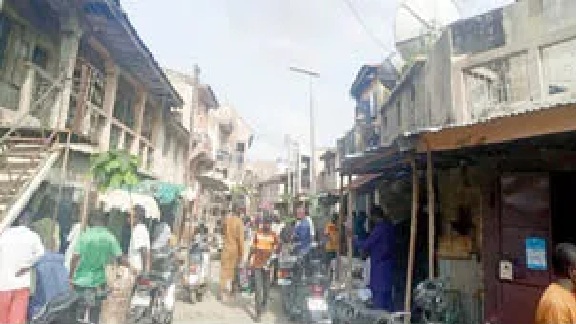
Fagge Quarters, one of the historic settlements in Kano State, is facing growing pressure from rapid commercial expansion, with residents saying the transformation is gradually eroding the character of the neighbourhood and forcing families to relocate.
The community, which dates back several centuries, was traditionally known as a residential settlement. Today, however, its streets are increasingly occupied by shops, warehouses, plazas, traders and other commercial activities as major markets surrounding the area continue to expand.
Fagge is strategically located close to some of Kano’s busiest commercial centres. Kantin Kwari textile market lies to the south, while Singer Market and the Beirut Road GSM hub are to the east. Kofar Wambai and the abattoir are located to the west, with Yankura and France Road markets to the north. Wapa, another major commercial area known for bureau de change operators and motorcycle trading, is also nearby.
The growing commercial pressure has increased the value of land in the area, encouraging some homeowners to sell their properties to traders. Residents said many of the houses are subsequently converted into shops, warehouses and plazas.
Nura Mai Unguwa, the ward head of Fagge B, said the settlement’s history could be traced to migrants from Agadez in present-day Niger Republic who settled in the area in the 17th century under the leadership of Usman Tambari.
He acknowledged that the expansion of commercial activity had brought economic benefits but said it had also increased congestion and placed pressure on schools, hospitals and other basic infrastructure.
According to him, the community has responded by establishing the Fagge Restore Committee to prevent the indiscriminate conversion of residential properties.
He said the committee, working with the Kano State House of Assembly, secured a resolution against the conversion of residential houses into shops and that 71 houses had subsequently been prevented from being converted into plazas.
For longtime residents, the issue goes beyond physical changes to buildings.
Muhammed Garba Fagge, a retired headmaster, recalled a period when the neighbourhood was predominantly residential and residents lived as a closely connected community. He said the increasing commercialisation was gradually destroying family houses and weakening longstanding community relationships.
He said many families had moved to areas including Rijiyar Lemo and Bachirawa because of rising rents and the increasing difficulty of finding residential accommodation in Fagge. Other displaced residents have reportedly moved farther away to areas such as Kurnar Asabe, Kwaciri, Dorayi and Gaida.
Another longtime resident, Muhammad Zakariyya, who has lived in Fagge for more than five decades, said the commercial takeover had made residential accommodation increasingly scarce.
He acknowledged that businesses had created economic opportunities, but argued that uncontrolled expansion could eventually leave the community without sufficient residential space.
The transformation has also brought complaints about traffic congestion, noise, waste disposal and drainage.
A recent report by Peoples Daily described Fagge as facing severe traffic gridlock, deteriorating infrastructure and rising concerns over insecurity, with traders and businesses increasingly occupying roads and residential streets. The report said trailers, roadside businesses and warehouses had encroached on parts of the neighbourhood.
Residents have also raised concerns about blocked drainage channels, market waste, dust and diesel fumes from heavy vehicles. Some said these problems become particularly serious during heavy rainfall, when blocked drainage can threaten nearby homes and roads.
Urban planning experts have warned that the situation could have long-term consequences if authorities fail to regulate land use.
Dr Murtala Uba, an urban and regional planning scholar at Bayero University, Kano, said residential and commercial areas should be clearly distinguished and properly regulated. He argued that the higher financial value of commercial property, combined with Fagge’s location among major markets, was creating strong pressure on families to sell ancestral homes.
Research on the evolution of Kano’s urban landscape also documents the significant commercial transformation of Fagge. A study published in the journal Urban Science found that more than 75 per cent of sampled houses in the Fagge area had commercial shops at the exterior, linking the transformation to infrastructure development, inheritance patterns and socioeconomic activities.
The challenge for authorities, therefore, is balancing the economic importance of Fagge’s commercial activity with the need to preserve residential space, heritage and liveable neighbourhoods.
Residents and planning experts are calling for stronger enforcement of land-use regulations, protection of residential properties and improved infrastructure.
Without effective intervention, residents fear that the historic neighbourhood could gradually lose its residential identity as commercial activities continue to spread into homes and streets.


