

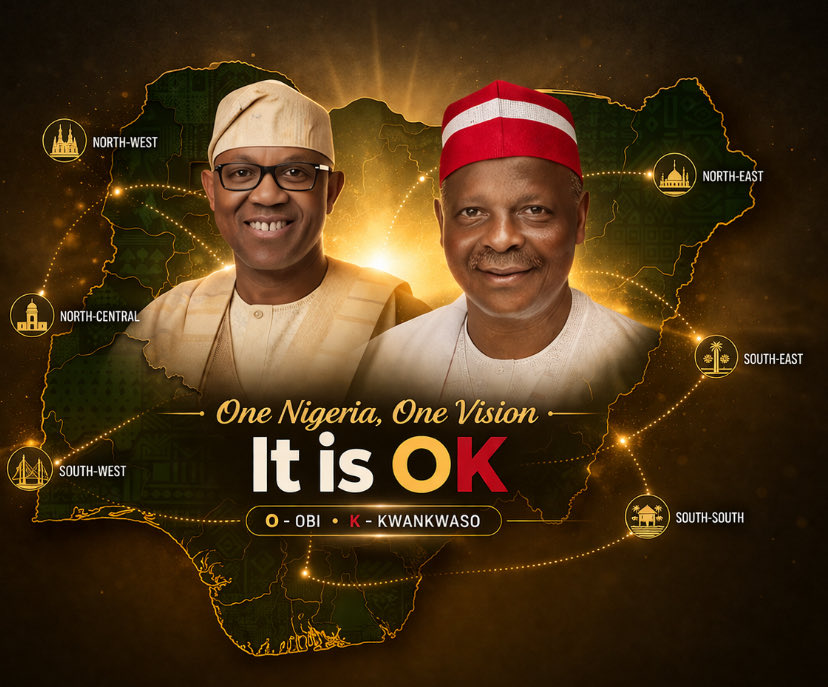
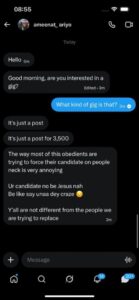
Fresh allegations have emerged suggesting that supporters of Bola Ahmed Tinubu are offering as much as ₦3,500 per post to social media users willing to publish content critical of Peter Obi.
According to claims circulating across online platforms, the alleged strategy is aimed at shaping public perception and countering Obi’s rising popularity ahead of the 2027 presidential election cycle. Observers note that Obi, the Labour Party’s 2023 presidential candidate, continues to command a strong and loyal grassroots following, particularly among young Nigerians.
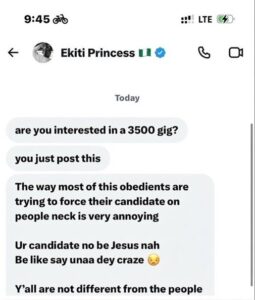
Political analysts argue that if true, such tactics reflect an increasingly aggressive digital battleground where narratives are weaponized to influence public opinion. The use of paid content—often disguised as organic commentary—has become a growing concern in Nigeria’s political communication space.
However, there has been no official confirmation or credible evidence from independent authorities to substantiate these claims. Neither the presidency nor the All Progressives Congress (APC) has publicly responded to the allegation at the time of this report.
Experts caution the public to approach such claims with skepticism, urging verification before amplification, especially as the country gradually inches toward another heated election season.
As political activities intensify, the role of social media in shaping voter perception is expected to remain a critical factor in Nigeria’s democratic process.
DEEPER INSIGHT: Alleged Digital Propaganda War Ahead of 2027 Elections
The claim that supporters of Bola Ahmed Tinubu are allegedly paying ₦3,500 per post to push negative narratives against Peter Obi points to a broader and more complex reality: Nigeria’s political battlefield is rapidly shifting from physical rallies to coordinated digital influence operations.
1. The Rise of Paid Political Messaging
Over the past decade, social media has evolved into a powerful political weapon in Nigeria. What used to be organic support has increasingly been replaced—or supplemented—by monetized engagement, where individuals are allegedly incentivized to:
Create viral posts attacking opponents
Amplify hashtags to manipulate trends
Share misleading or unverified claims to sway public opinion
If the ₦3,500 allegation holds any truth, it would suggest a structured micro-payment system, designed to flood platforms with repetitive messaging—making it appear widespread and credible.
2. Why Peter Obi Becomes a Target
Peter Obi remains one of the most discussed opposition figures since the 2023 elections. His perceived strengths include:
Strong youth and urban support base
“Clean governance” narrative
Continued visibility even outside election cycles
This growing influence may naturally attract political pushback from rivals aligned with Bola Ahmed Tinubu, especially as early positioning for 2027 begins.
3. Narrative Control as a Political Strategy
Modern campaigns are no longer just about policies—they are about perception management. Alleged tactics like this serve three main purposes:
Discrediting opponents: Creating doubt about credibility or competence
Agenda setting: Forcing certain topics into national conversation
Emotional manipulation: Triggering outrage, fear, or division
When repeated at scale, even weak claims can begin to feel true—a phenomenon known as the “illusion of truth effect.”
4. The Role of “Digital Foot Soldiers”
A key feature of such operations is the use of loosely coordinated individuals, sometimes referred to as:
Influencers
Content creators
Anonymous accounts (“burner” profiles)
These actors may not be formally linked to any campaign but can still function as informal propaganda channels, especially when financial incentives are involved.
5. The Evidence Gap
It is crucial to emphasize that:
There is no verified, publicly available proof confirming a ₦3,500 payment scheme
Much of the claim currently exists within political discourse and online speculation
Without documented transactions, whistleblower testimony, or investigative reporting, the allegation remains unproven.
6. What This Means for Nigerians
Whether true or not, the conversation highlights a real risk:
Information pollution is increasing
Voters may struggle to separate fact from manipulation
Trust in democratic processes could erode
Bottom Line
The allegation reflects a growing concern about digital propaganda in Nigerian politics, where influence can be bought, narratives engineered, and public opinion subtly shaped.
As 2027 approaches, citizens will need to become more digitally vigilant, questioning not just what they see—but who benefits from them seeing it.


