

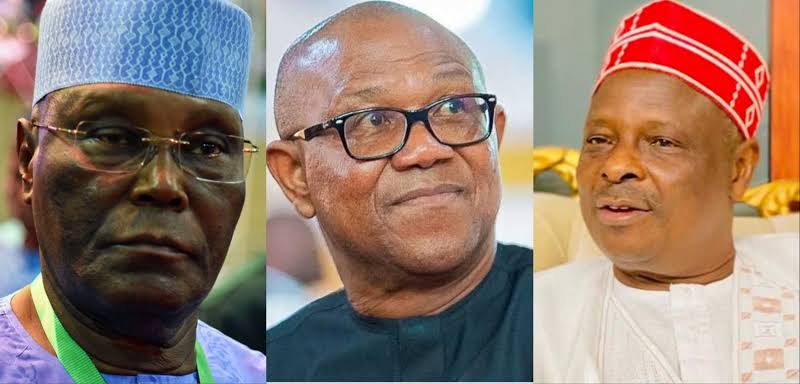
Fresh controversy is trailing the ongoing opposition coalition talks after unconfirmed reports emerged that former Vice President Atiku Abubakar allegedly presented strict conditions before agreeing to support Peter Obi as a consensus presidential candidate for the 2027 presidential election.
The reports, said to be coming from Atiku’s political camp, claim that he is willing to step aside for Obi under the African Democratic Congress coalition arrangement—but only if certain political and strategic demands are met.
According to the unverified claims, Atiku’s conditions include excluding Rabiu Musa Kwankwaso from any vice-presidential consideration, ensuring that the vice-presidential slot comes from his own camp, and retaining control over major power centers of government including NNPC, CBN, Finance, and Defence.
Perhaps the most controversial aspect of the reports is the alleged demand for a ₦50 billion “consensus mobilization fee” before the party convention, alongside a request for Atiku to serve as Chairman of the Presidential Policy Council with veto power over major policy decisions.
If true, political observers say such demands could fundamentally alter the meaning of a Peter Obi presidency.
Many Nigerians supporting the idea of an Obi presidency see him as a symbol of reform, independence, and a break from old political structures. However, critics argue that surrendering strategic institutions such as the Nigerian National Petroleum Company, the Central Bank of Nigeria, the Ministry of Finance, and the Defence structure to one political bloc would leave the president with limited real authority.
This has raised a major question: what exactly would be left for Obi to govern?
Analysts say that control of NNPC means influence over Nigeria’s oil wealth and revenue structure. Control of CBN means influence over monetary policy, currency direction, and banking stability. Finance determines national budgeting, revenue allocation, and fiscal priorities, while Defence controls national security architecture.
Together, these institutions represent the backbone of executive power in Nigeria.
Many believe that if these sectors are effectively handed to Atiku’s camp, Obi could become president in title while real political leverage remains elsewhere.
This concern has fueled arguments that such an arrangement could make governance difficult, weaken public trust, and damage Obi’s reputation before even assuming office.
Some political commentators have gone further to argue that if Obi enters office with such heavy political debts and elite compromises, he may struggle to fulfill the expectations of Nigerians seeking genuine change.
Others insist coalition politics requires negotiation, compromise, and power balancing, especially in a country as politically complex as Nigeria. They argue that defeating President Bola Ahmed Tinubu and the ruling All Progressives Congress may require difficult political sacrifices.
Still, the alleged ₦50 billion demand has generated the strongest backlash, with many describing it as morally troubling at a time when millions of Nigerians are battling inflation, poverty, and economic hardship.
Supporters of Atiku, however, caution against rushing to judgment, noting that the reports remain unconfirmed and may be part of political propaganda aimed at creating division within the coalition.
As of now, neither Atiku Abubakar, Peter Obi, nor the ADC leadership has officially confirmed the claims.
Nevertheless, the reports have exposed the fragile nature of opposition unity and the difficult negotiations behind the scenes as leaders attempt to build a formidable alliance for 2027.
For many Nigerians, the real question remains simple: will the coalition be built on personal ambition and political bargaining, or on genuine national rescue and the desire to deliver a better future for the people?


