

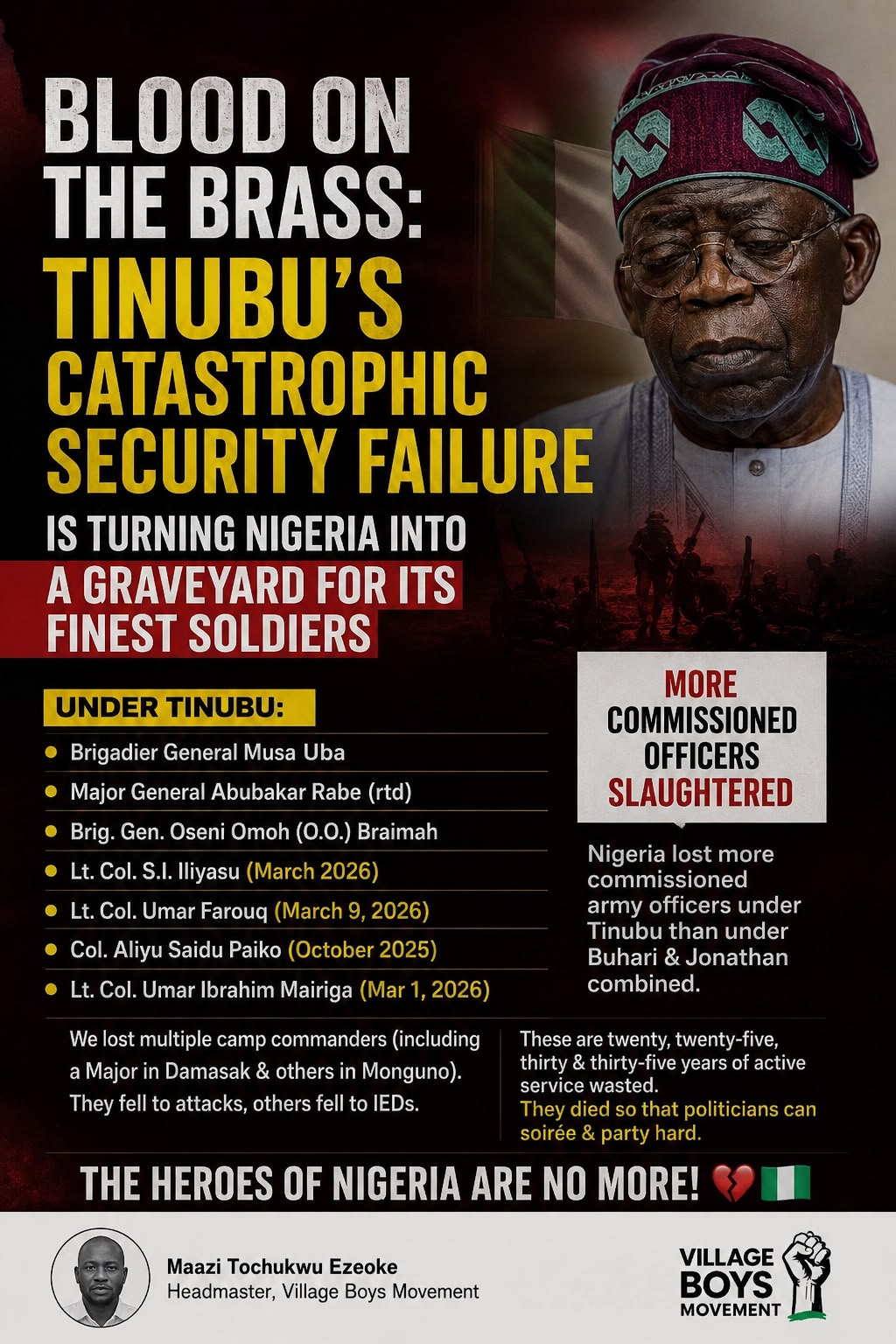
A nation that struggles to protect its soldiers inevitably faces difficult questions about the strength of its institutions and the effectiveness of its security architecture. When commissioned officers—men who dedicated decades of their lives to defending Nigeria—die in combat, ambushes, or attacks by insurgents and terrorists, concerns naturally arise about the state of national security.
Under President Bola Ahmed Tinubu’s administration, insecurity remains one of Nigeria’s most pressing challenges. The repeated deaths of senior military officers have renewed debate over the effectiveness of intelligence gathering, troop protection, operational planning, and strategic leadership.
The deaths of Brigadier General Musa Uba, Major General Abubakar Rabe (rtd), Brigadier General Oseni Omoh Braimah, Lt. Col. S.I. Iliyasu, Lt. Col. Umar Farouq, Col. Aliyu Saidu Paiko, and Lt. Col. Umar Ibrahim Mairiga have sparked concerns within the public and among security observers about the resilience of Nigeria’s security institutions.
These were experienced officers whose careers spanned decades of service. Their losses represent not only personal tragedies for their families and colleagues but also significant setbacks for institutional memory and military operations.
Critics argue that a disconnect exists between the realities on the battlefield and political priorities in Abuja. While troops confront insurgents, terrorists, and armed criminal groups across multiple theatres of operation, political actors remain focused on power dynamics and preparations for future elections.
Comparisons have been drawn with past administrations. Under former President Olusegun Obasanjo, himself a retired military officer, Nigeria faced security challenges of its own. However, some analysts contend that there was a stronger perception of command authority and institutional discipline during that period.
Internationally, the deaths of multiple senior military officers within a short period often trigger extensive reviews of military doctrine, intelligence systems, and operational strategies. In many democracies, such incidents prompt legislative scrutiny and reassessment of national security policies.
In Nigeria, repeated military funerals have intensified calls for reforms. Security experts have advocated improved intelligence coordination, enhanced troop welfare, better equipment procurement, and stronger force protection measures for personnel operating in conflict zones.
The Tinubu administration inherited longstanding security challenges, including insurgency, banditry, separatist violence, and communal conflicts. Nevertheless, governments are ultimately judged by their ability to respond effectively to inherited crises and improve conditions over time.
One growing concern is the normalization of military casualties. As attacks continue in various regions, there are fears that repeated losses may affect morale within the armed forces and public confidence in the state’s ability to provide security.
The fallen officers served with the belief that Nigeria was worth defending. Their sacrifices place an obligation on the state to strengthen institutions, improve military preparedness, and pursue policies capable of safeguarding both security personnel and civilians.
Ultimately, Nigerians will judge their leaders not merely by promises or rhetoric, but by measurable improvements in security and the preservation of human life.
Maazi Tochukwu Ezeoke
Headmaster, Village Boys Movement
Editorial observations
Statements such as “catastrophic security failure,” “graveyard for its finest soldiers,” and “incompetence at the highest levels” are opinion and should be clearly presented as commentary rather than established fact.
Claims comparing the frequency of military deaths under different administrations should ideally be supported by verifiable casualty data.
Assertions that the government is “helping make their deaths inevitable” may expose publishers to defamation concerns unless framed as opinion or backed by evidence.
Distinguishing between terrorists, insurgents, bandits, and other armed groups is important because Nigeria’s security landscape involves multiple actors with differing legal classifications.


