

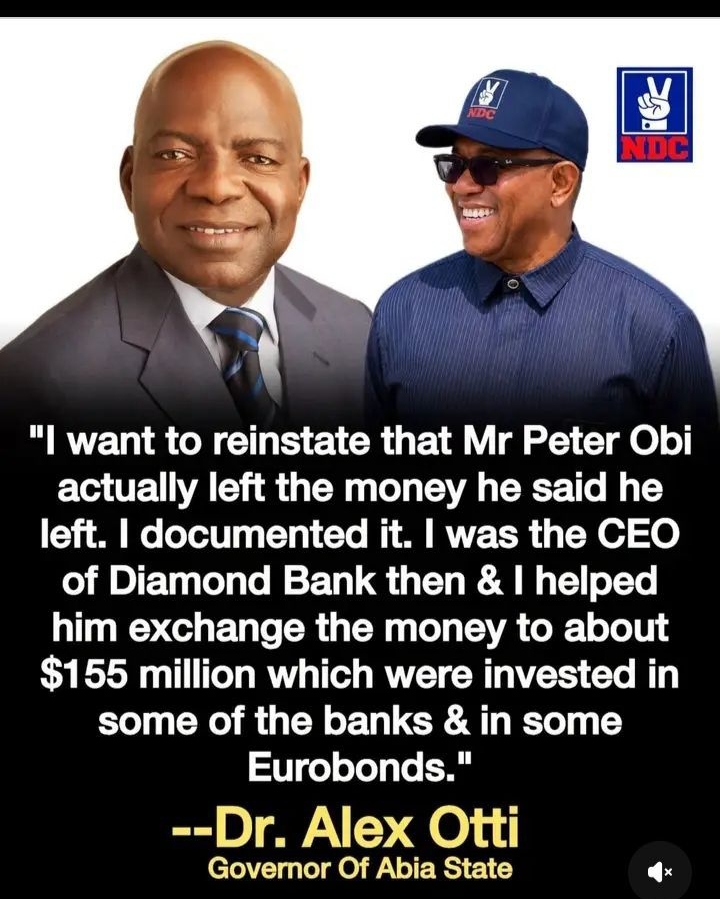
Abia State Governor, Alex Otti, has repeatedly affirmed that former Anambra State Governor Peter Obi left about $155 million in foreign-currency investments for the state, providing a detailed account of his own involvement in the financial arrangements.
Otti’s account is particularly notable because, at the time the transactions were being arranged, he was the Chief Executive Officer of Diamond Bank. In a 2022 public statement, Otti said he personally assisted Obi with the conversion of the funds and the investment strategy adopted for the money.
According to Otti, Obi initially intended to leave the funds in cash, but discussions with the bank led to a decision to invest the money rather than allow it to remain idle. Otti said he personally helped convert the naira into approximately $155 million, which was subsequently invested in Tier-2 capital instruments of Nigerian banks and in Eurobonds.
Otti had also explained in an earlier 2020 article that the dollar investment was placed in financial instruments with maturities of about five years and interest rates of up to nine per cent. He said the investments were made for the benefit of Anambra State and were structured as long-term assets rather than ordinary cash balances.
The account provides important context to the longstanding controversy over what Obi left behind when he handed over power in March 2014. Obi himself subsequently stated that his administration had saved $156 million, alongside substantial naira savings and funds earmarked for specific projects.
The distinction is important: the $155 million figure refers to investments, rather than money simply sitting as physical cash in a government bank account. That point has sometimes been lost in the political arguments surrounding the former governor’s financial record.
Otti’s earlier account also put the value of the dollar investment in naira terms at more than ₦95 billion by 2020 under the assumptions he outlined concerning interest and currency movements.
There is, however, a documented historical complication. A 2015 account attributed to the Obiano administration said the state had invested $155 million in Eurobonds and other foreign-denominated securities held with Access Bank, Fidelity Bank and Diamond Bank, while also reporting a lower market value at that particular point because of market conditions. This illustrates why the original investment amount should not automatically be equated with its market value at every point in time.
What remains significant in the present debate is Otti’s firsthand account of the transaction. He has consistently maintained that he was directly involved in helping Obi convert and structure the funds as investments for Anambra State. His testimony therefore adds the perspective of a banking executive who participated in the financial process, rather than merely a political commentator discussing events from outside.
The issue has regained attention amid renewed political arguments over Obi’s record in Anambra and competing claims concerning the state’s finances before and after his administration.
While Otti’s testimony is substantial evidence of his account of the transaction, a complete independent reconstruction of Anambra’s historical finances would require examination of the state’s audited accounts, investment certificates, bank records and subsequent redemption or rollover documents.
Nevertheless, the central point in Otti’s testimony is clear: he says he personally helped Peter Obi convert approximately $155 million of Anambra’s funds and place the money into structured investments intended to preserve and grow the state’s assets.


