

The Akwa Ibom State Government says it is repositioning agriculture from subsistence farming into a major driver of employment, food security and wealth creation across the state.
The Commissioner for Agriculture, Dr Offiong Offor, disclosed this on Thursday during an interaction with journalists in Uyo, where she reviewed the administration’s interventions in the agricultural sector.
Offor said the government was implementing a range of programmes aimed at increasing agricultural production, improving farmers’ livelihoods and encouraging more residents, particularly young people, to return to farming.
She said agriculture remained central to Akwa Ibom’s economy, noting that the state had a predominantly agrarian population engaged in the production of crops including cassava, vegetables, oil palm and cocoa.
According to the commissioner, the government is addressing some of the challenges limiting agricultural productivity through mechanisation, improved farm inputs, rural infrastructure and market access.
She said the administration’s Back to Farm and Home Farm initiatives were designed to encourage households to cultivate food crops for their own consumption while also creating opportunities to generate additional income.
Offor explained that the Home Farm initiative was intended to revive the practice of growing basic food items around homes, reducing dependence on purchased food and providing households with an additional source of livelihood.
The commissioner also disclosed that the state had established an Equipment Leasing Company through which farmers could access tractors and other agricultural machinery at a 50 per cent subsidy.
She said the intervention would enable farmers to cultivate larger areas more efficiently and reduce dependence on manual labour.
Another major component of the government’s agricultural strategy is the Rural Access and Agricultural Marketing Project, a World Bank-assisted programme supported by counterpart funding from the state government.
Offor said the project had identified 486 rural roads across Akwa Ibom’s 31 local government areas for intervention.
She explained that improving feeder roads would make it easier for farmers to transport produce to markets, reduce post-harvest losses and improve rural livelihoods.
An 11-kilometre market-junction road crossing parts of Ibesikpo Asutan Local Government Area has already been commissioned under the programme, she added.
The commissioner further said agricultural inputs had been distributed to thousands of farmers through the Food Systems Resilience Programme and Akwa Ibom State’s implementation of the Nigeria Community Action for Resilience and Economic Stimulus programme, known as AK-CARES.
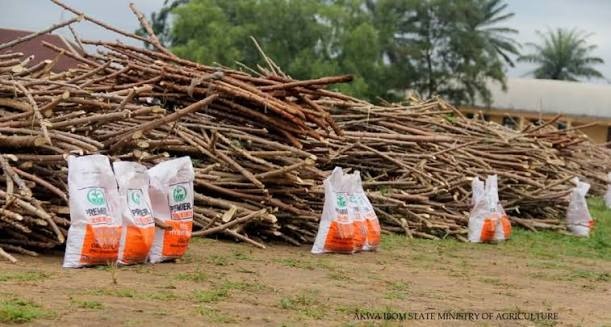
Beneficiaries, she said, had received improved fingerlings, poultry, goats and sheep, as well as cassava cuttings, fertilisers and herbicides.
More than 16,000 beneficiaries have received input support under AK-CARES, while over 150 rural roads have been graded and 81 wet markets rehabilitated with facilities including toilets and slaughter slabs, according to the commissioner.
The state is also focusing on tree crops as part of its agricultural expansion strategy.
Offor said more than 620,000 oil palm seedlings would be distributed to 1,700 farmers across the state’s 31 local government areas. She added that 14 local government areas had so far received 5,000 seedlings each.
The oil palm programme forms part of Governor Umo Eno’s broader Tree Crop Revolution initiative, which was launched in May with the stated objective of expanding production and restoring the crop’s economic importance in the state.
In the cocoa subsector, Offor said more than 250,000 seedlings were distributed to over 3,000 farmers in 2025, while more than 100,000 seedlings had been distributed to over 850 farmers in 2026.
She added that the government was tracing the origin of cocoa produced in Akwa Ibom to ensure that the state’s produce could be properly identified and marketed.
The commissioner also disclosed plans for a 50-hectare Model Farm that would combine crop and livestock production. The project is expected to serve as a model that could subsequently be replicated across the state’s three senatorial districts.
The agricultural initiatives form part of a wider economic strategy by the Eno administration. In July, the state government approved N31bn for an economic empowerment programme targeting 165,912 residents across the 31 local government areas, including farmers, youths, women, traders and small businesses.
Offor said the ultimate objective was to make agriculture more productive and commercially viable while creating sustainable opportunities for residents.
The state’s agricultural investment strategy also includes efforts to attract private capital into the sector. The Akwa Ibom Agricultural Investment Directorate says its mandate includes identifying viable agricultural projects, coordinating investments and promoting domestic and foreign investment in agriculture.
With the combination of mechanisation, improved inputs, rural roads, tree-crop development and market infrastructure, the government says agriculture can increasingly serve not only as a source of food but also as a pathway to employment and wealth creation in Akwa Ibom.


