

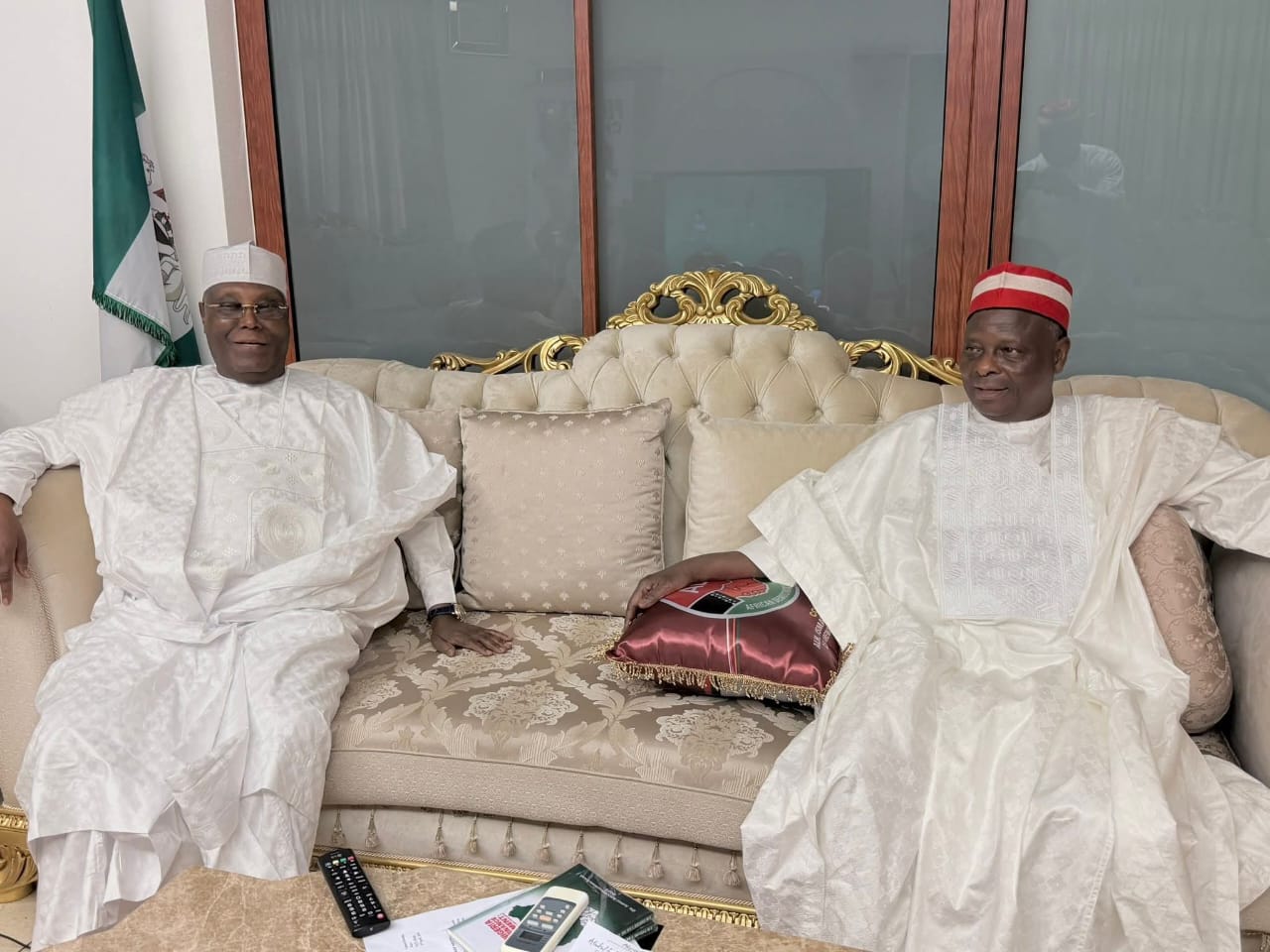
Abuja — Former Vice-President Atiku Abubakar on Friday paid a high-profile visit to former Kano State Governor, Senator Rabiu Musa Kwankwaso, at his Maitama residence in Abuja, in what observers interpret as a strategic political move following recent controversies.
The meeting, which occurred shortly after the Jumu’ah prayers, was confirmed by Kwankwaso’s media aide, Saifullahi Hassan. While official details remain limited, sources suggest the discussion was focused on evolving political dynamics and alignments ahead of the 2027 general elections.
The visit comes on the heels of heightened political tension sparked by Atiku’s recent remarks during an appearance on Arise TV, which have generated significant reactions across political circles, particularly among northern stakeholders and members of the Kwankwasiyya movement.
Analysts view the meeting as a possible attempt to mend fences and consolidate northern political influence amid growing realignments within opposition blocs. Both Atiku and Kwankwaso remain key figures whose cooperation—or lack thereof—could significantly shape the trajectory of coalition politics in the coming election cycle.
As of press time, neither camp has released an official statement detailing the outcome of the engagement, leaving room for speculation over potential alliances or reconciliatory efforts underway.
The backlash from Arise TV interview has quickly evolved beyond a media controversy into a catalyst for deeper internal political recalibration ahead of 2027.
At the core of the issue is how Atiku Abubakar’s remarks were perceived—particularly among northern stakeholders and loyalists of Rabiu Musa Kwankwaso—as dismissive or politically provocative. In a region where influence, respect, and coalition-building are critical, such perceptions can disrupt fragile alliances.
How this connects to internal party alignment:
1. Strained Trust Within Opposition Blocs
The opposition space—especially among parties like PDP, NNPP, and emerging coalitions—relies heavily on trust between power brokers. The interview backlash has widened skepticism around Atiku’s willingness to accommodate other strong contenders like Kwankwaso, complicating ongoing coalition talks.
2. Northern Power Equation Under Pressure
The North remains a decisive electoral bloc. Any perceived slight against a figure like Kwankwaso risks fragmenting northern unity. This forces political actors to reassess alignments to avoid splitting votes, making reconciliation efforts—like Atiku’s visit—strategically necessary.
3. Reinforcement of Political Camps
Rather than weakening rivals, the controversy has, in some ways, strengthened internal loyalty within the Kwankwasiyya movement. It reinforces Kwankwaso’s image as an independent force, making negotiations more complex and less likely to result in a subordinate role within any alliance.
4. Urgency of Coalition Negotiations
With 2027 approaching, time is a critical factor. The backlash has accelerated behind-the-scenes talks, as political actors now recognize that unresolved tensions could derail broader coalition efforts needed to challenge incumbency.
5. Image Management and Electability
Public perception plays a major role in alignment decisions. Allies and undecided stakeholders are now weighing whether Atiku’s media outings help or hurt the broader opposition narrative, influencing who becomes the rallying point for a unified ticket.
Bottom Line:
The Arise TV fallout is not just about media optics—it has exposed underlying fractures, forced urgent political outreach, and reshaped the negotiation dynamics among key opposition figures. The meeting between Atiku and Kwankwaso is therefore less about courtesy and more about damage control and strategic positioning in a rapidly evolving 2027 landscape.


