

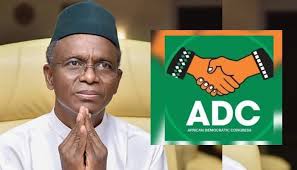
The African Democratic Congress (ADC) has raised concerns over the reported detention of former Kaduna State governor Nasir El-Rufai, describing the incident as part of a broader pattern aimed at weakening opposition voices in Nigeria’s political space.
In a strongly worded reaction, the party alleged that any attempt to detain or intimidate prominent opposition figures is designed to suppress dissent and discourage political participation ahead of future elections.
The comments have added fresh tension to Nigeria’s already heated political climate, where opposition parties continue to accuse authorities of targeting critics and restricting democratic freedoms.
ADC Raises Alarm Over Opposition Treatment
The ADC stated that the alleged treatment of El-Rufai should be seen as part of a worrying trend in which opposition politicians are increasingly subjected to pressure, intimidation, or legal challenges that may affect their ability to operate freely.
According to the party, such actions—whether formal or informal—risk undermining Nigeria’s democratic process and eroding public confidence in political institutions.
Party representatives argued that democracy thrives only when all political actors, regardless of affiliation, are allowed to express their views without fear of harassment or politically motivated detention.
They warned that any perception of selective justice or politically influenced law enforcement could deepen mistrust between citizens and government institutions.
El-Rufai’s Influence in National Politics
Nasir El-Rufai, a former governor of Kaduna State and a prominent figure in Nigerian politics, has remained an influential voice in national debates even after leaving office.
Known for his outspoken positions on governance, economic reform, and national security, El-Rufai has often attracted both support and criticism across political lines.
His recent political activities and comments have kept him in the spotlight, making him one of the most closely watched figures in opposition politics.
The ADC argues that targeting individuals of his political standing sends a broader message to other opposition leaders and supporters across the country.
Allegations of Political Intimidation
In its reaction, the ADC described the reported detention as part of what it called an “attempt to break opposition spirit” in Nigeria.
The party claimed that opposition figures have increasingly faced pressure through legal actions, security scrutiny, and political intimidation, particularly in the lead-up to major electoral cycles.
While the ADC did not provide detailed evidence regarding the specific circumstances surrounding El-Rufai’s alleged detention, it insisted that the development reflects a troubling trend that must be addressed urgently.
Political analysts note that allegations of intimidation and selective enforcement are not new in Nigeria’s political environment, where tensions between ruling and opposition parties have historically escalated during election periods.
Calls for Democratic Accountability
The ADC called on security agencies and relevant authorities to remain neutral and uphold democratic principles in their handling of political figures.
The party stressed that law enforcement must not be used—directly or indirectly—as a tool to silence opposition voices or influence political outcomes.
It further urged civil society organizations, human rights groups, and international observers to pay closer attention to Nigeria’s political environment and ensure that democratic standards are upheld.
According to the party, protecting political freedoms is essential for maintaining stability and public trust in Nigeria’s electoral system.
Broader Political Tensions in Nigeria
The controversy comes amid ongoing political tensions in Nigeria as parties begin positioning themselves ahead of future elections.
Opposition groups have repeatedly accused the government of using state institutions to weaken rivals, while the ruling party has consistently denied such allegations, insisting that law enforcement agencies operate independently.
These recurring disputes have contributed to a highly polarized political environment, where almost every major political development is interpreted through a partisan lens.
Analysts say that such tensions are likely to intensify as the country moves closer to the next general election cycle, with increased scrutiny of political leaders and alliances.
El-Rufai and the National Conversation
El-Rufai’s political profile has made him a frequent subject of national debate, particularly on issues related to governance reforms, security challenges, and party politics.
His critics often accuse him of being controversial and polarizing, while his supporters describe him as a reform-minded leader unafraid to challenge established interests.
Because of his influence and outspoken nature, any incident involving him tends to attract widespread public attention and political interpretation.
The ADC’s comments reflect how individual political figures in Nigeria often become symbols of broader struggles between ruling and opposition camps.
Reactions From Political Observers
Political observers have noted that allegations of detention or intimidation—whether proven or disputed—often escalate quickly into broader political narratives in Nigeria.
Some analysts caution that without verified details, such claims risk further deepening mistrust between political actors and security institutions.
Others argue that the perception of unfair treatment, even without full confirmation, can still have significant political consequences by shaping public opinion and influencing voter sentiment.
The lack of clear official clarification at the time of reporting has also contributed to speculation and heightened reactions across political circles and social media platforms.
Civil Society and Democratic Concerns
Civil society groups have repeatedly emphasized the importance of protecting political freedoms and ensuring that all citizens, including politicians, are treated fairly under the law.
They argue that democratic systems depend on transparency, accountability, and equal application of justice regardless of political affiliation.
Many organizations have called for clearer communication from authorities during politically sensitive incidents to avoid misinformation and unnecessary escalation.
Growing Focus on 2027 Elections
As Nigeria gradually moves toward the 2027 general elections, political parties are intensifying their strategies, alliances, and public messaging.
Observers say that early positioning is already influencing how political events are interpreted, with opposition parties particularly sensitive to actions involving their key figures.
The ADC’s reaction to El-Rufai’s alleged detention highlights how quickly political developments can escalate into national debate during election preparation periods.


