

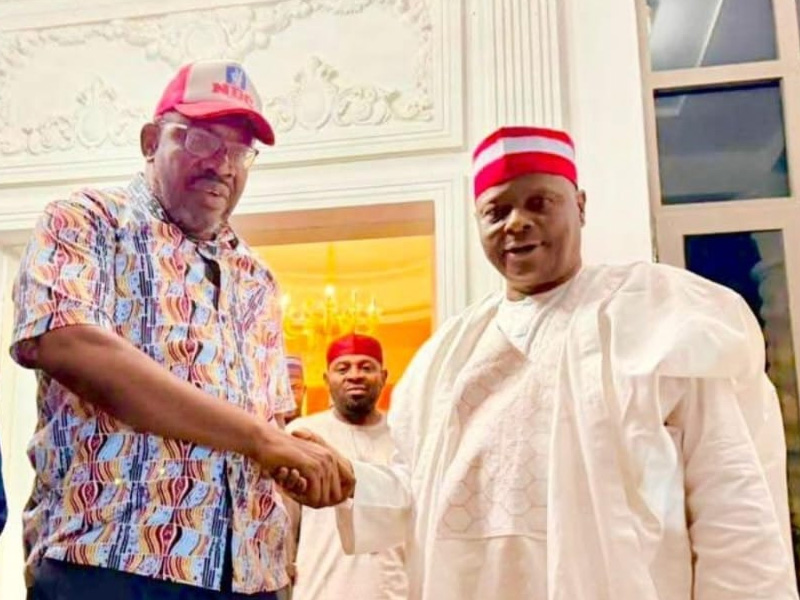
Former Bayelsa State Governor and Senator representing Bayelsa West, Seriake Dickson, has provided insight into his recent engagement with Senator Rabiu Musa Kwankwaso, following political tensions arising from developments within the National Democratic Congress (NDC) primary process.
Dickson clarified that his discussion with the former Kano State governor centered on national political stability, democratic values, and the importance of maintaining dialogue among political stakeholders despite emerging differences within party structures.
The meeting has attracted public attention amid speculation about possible political realignments and consultations among prominent Nigerian political figures ahead of future electoral cycles.
Dickson Explains Purpose of Engagement
Speaking on the matter, Dickson emphasized that his interaction with Kwankwaso was not centered on controversy but on broader issues affecting Nigeria’s democratic system.
He noted that experienced political leaders have a responsibility to engage in constructive conversations that promote national unity and strengthen democratic institutions.
According to him, discussions between senior politicians should not always be interpreted through the lens of rivalry or political maneuvering, but rather as part of ongoing efforts to stabilize the political environment.
Dickson stressed that Nigeria’s democratic progress depends on continuous engagement among leaders across party lines.
Context of Political Developments
The meeting comes at a time of heightened political activity and repositioning among key political actors in the country.
Recent internal party developments within various political platforms have sparked discussions about alliances, leadership direction, and strategic positioning ahead of future elections.
Although the National Democratic Congress (NDC) primary outcome has generated debate among supporters and observers, Dickson maintained that political disagreements are a normal part of democratic processes.
He argued that what matters most is how political actors manage differences while maintaining respect for institutions and democratic principles.
Kwankwaso’s Role in National Politics
Senator Rabiu Musa Kwankwaso, a former governor of Kano State and presidential candidate in previous elections, remains a significant figure in Nigeria’s political landscape.
His influence within northern politics and his leadership of the New Nigeria Peoples Party (NNPP) have continued to shape national political discussions.
Kwankwaso has been involved in several consultations with political stakeholders in recent months, as parties and leaders prepare for future political alignments.
Observers believe that engagements involving figures like Kwankwaso often attract attention due to their potential implications for broader political realignments.
Emphasis on Dialogue and Stability
Dickson reiterated the importance of dialogue among political leaders, especially during periods of political tension or uncertainty.
He stated that sustained communication among politicians helps to reduce misunderstandings and promotes peaceful political engagement.
According to him, Nigeria’s democracy benefits when leaders prioritize national interest over personal or partisan disagreements.
He further noted that the country’s diversity requires continuous negotiation and collaboration among stakeholders to maintain stability.
Reactions to the Meeting
The disclosure of the meeting between Dickson and Kwankwaso has generated reactions across political circles and social media platforms.
Some analysts view the engagement as a routine consultation between experienced politicians, while others interpret it as part of broader political positioning ahead of future elections.
Supporters of both figures have largely welcomed the discussion, describing it as a positive step toward strengthening political dialogue.
However, some political commentators have urged caution in interpreting such meetings as indicators of formal alliances or political shifts.
Broader Political Implications
Political analysts suggest that interactions between senior political figures are increasingly common as Nigeria moves closer to another electoral cycle.
These engagements often reflect efforts to build consensus, explore partnerships, or simply maintain communication channels within the political elite.
Experts argue that while such meetings may not always produce immediate political outcomes, they often contribute to shaping future alignments.


