

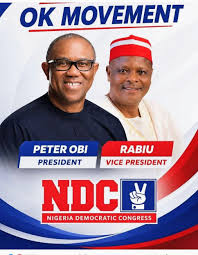
Over the last few days, social media has been awash with anger, frustration, and outright outrage from some members of the Obidient movement over the outcome of the NDC’s primary elections. Many who joined the party only recently appear shocked that they were unable to secure tickets or influence outcomes within the party structure.
The reaction raises an important question: what exactly did they expect?
There seems to be a growing tendency among some newcomers to forget that the National Democratic Coalition (NDC) existed before Peter Obi and Rabiu Musa Kwankwaso arrived. The party did not suddenly emerge four months ago. While its formal registration by INEC was only recently finalized following a court judgment, the struggle for recognition and registration lasted years. Party members invested time, resources, and political capital long before the current wave of enthusiasm arrived.
That history matters.
The NDC is not merely a political vehicle assembled overnight to accommodate the ambitions of any single political movement. It has its own leadership, its own internal culture, and its own loyal membership base. Long before the arrival of the Obi-Kwankwaso coalition, the party had developed strategies for participating in the 2027 elections. Whether those plans included fielding a presidential candidate immediately is beside the point. The party had already made commitments, cultivated aspirants, and built expectations among members who remained loyal during difficult years.
It is therefore unrealistic to expect those individuals to be pushed aside simply because a more popular political movement has arrived.
At the center of this debate is Senator Seriake Dickson, the party’s National Leader. Anyone familiar with his political career knows he is not a leader who can easily be pressured into abandoning established structures. He is known for accommodating diverse interests where possible, but he is equally known for making decisions based on what he believes serves the long-term interests of the party.
One of those interests is loyalty.
Political parties survive because people commit themselves to building institutions over time. If those who stood with the NDC through years of uncertainty are suddenly displaced by individuals who only joined weeks before the primaries, what message would that send to party faithful across the country?
The reality is that many of those now expressing disappointment had little or no connection to the NDC until very recently. Some did not believe in the party. Some were not involved in its growth. Others viewed it merely as a convenient platform created by the momentum surrounding Peter Obi’s popularity.
Politics, however, rarely works that way.
Parties reward loyalty, relationships, and institutional commitment. That is not unique to the NDC; it is how political organizations function everywhere.
Another factor contributing to the current frustration is Peter Obi’s leadership style. Unlike many Nigerian politicians, Obi has traditionally shown little interest in dictating who emerges as candidates in party primaries. He tends to allow political processes to take their course, preferring competition over direct intervention.
While many supporters view this as principled and democratic, others may interpret it differently when they find themselves on the losing side of internal contests. For aspirants who expected Obi’s endorsement to guarantee victory, the reality has been sobering.
Rabiu Musa Kwankwaso, by contrast, operates with a more structured and hands-on political machinery. His movement is disciplined, organized, and experienced in navigating party processes. Together with Seriake Dickson, he understands the mechanics of internal party politics and has demonstrated an ability to protect and advance the interests of loyal supporters.
Peter Obi has largely chosen not to play that role.
As a result, many aspirants who entered the race expecting the “Obi effect” to automatically translate into party tickets have been disappointed. Some may eventually migrate to other political parties where nomination windows remain open.
That is their right.
But the broader lesson remains unchanged: the NDC does not belong to Peter Obi. It does not belong to Rabiu Musa Kwankwaso either. It is a political party with its own identity, leadership structure, and institutional interests.
For now, until campaign season formally begins, the person steering that vehicle is Senator Seriake Dickson.
Those entering the party must understand that reality rather than assume that popularity alone can overturn years of political investment, loyalty, and organization.
Politics is ultimately about institutions, not just personalities. The sooner that lesson is understood, the easier it will be for disappointed aspirants and their supporters to navigate the realities of the NDC.
-By Ogbuefi Ndigbo


