

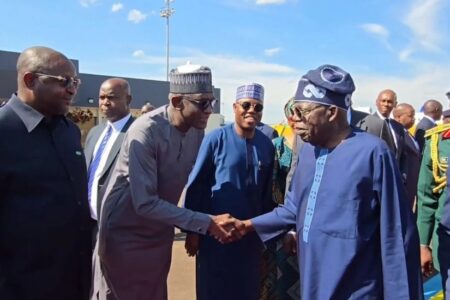
President Bola Ahmed Tinubu has drawn both praise and criticism following his remarks on tax reform and digital payment systems at the Africa CEO Forum in Kigali, Rwanda, where he outlined strategies aimed at improving revenue collection and expanding financial inclusion across Nigeria and West Africa.
The president’s comments, made during a high-level discussion on governance and economic transformation, quickly sparked intense debate among Nigerians, with supporters applauding his emphasis on simple tax laws and digital payments while critics questioned the clarity and relevance of parts of his response.
The exchange has since become one of the most talked-about moments from the continental business summit, reflecting Nigeria’s continuing political and economic divisions amid ongoing reform efforts.
Tinubu Calls for Simpler Tax Laws
During the forum, Tinubu addressed challenges surrounding taxation in West Africa, particularly the difficulties governments face in collecting revenue from large informal economies.
According to the president, complicated tax regulations and inefficient payment systems discourage many citizens and small businesses from complying with tax obligations.
He argued that governments should focus on creating tax systems that are simple, transparent, and easy for ordinary people to understand.
Tinubu also highlighted the role of technology in modernising tax administration, suggesting that mobile phone-based payment systems could significantly improve compliance and reduce barriers for millions of Nigerians operating outside formal financial structures.
The president stated that Nigeria’s current reforms are designed to make self-assessment and digital tax payments easier while reducing opportunities for corruption and revenue leakages.
Digital Payments Take Center Stage
A major focus of Tinubu’s remarks involved expanding the use of digital payment platforms for tax collection.
Nigeria has one of Africa’s largest informal economies, with millions of traders, artisans, and small business operators conducting transactions outside formal banking and taxation systems.
Tinubu argued that mobile payment technology offers governments an opportunity to broaden the tax base without creating excessive bureaucratic obstacles for citizens.
Supporters of the administration say digital systems could improve transparency, reduce tax evasion, and help Nigeria generate more internally generated revenue beyond oil earnings.
Economic experts have increasingly pointed to digital financial inclusion as an important tool for improving public finance management across developing economies.
Critics Say Trust Issues Were Ignored
Despite the support from some observers, the president’s remarks also generated criticism from political opponents and online commentators.
Several critics argued that the discussion around taxation in Nigeria goes beyond technology and simplified laws, insisting that many citizens hesitate to pay taxes because of low confidence in public institutions.
Others described parts of Tinubu’s response as unclear or not directly addressing concerns raised during the forum discussion.
Some social media users argued that taxpayers are more willing to comply when governments provide visible improvements in public services such as roads, healthcare, electricity, and education.
According to critics, successful tax reform requires not only digital tools and legal changes but also stronger accountability and public trust in governance.
Supporters Defend Tinubu’s Economic Vision
Supporters of President Tinubu defended his comments, describing them as practical proposals suited to the realities of African economies with large informal sectors.
Some praised his confident presentation style during the forum and argued that he effectively projected Nigeria as a country pursuing economic modernisation and investment opportunities.
Others pointed out that simplified tax systems and digital payments are widely recognised globally as effective methods for improving revenue collection and reducing leakages.
Backers of the administration also referenced Tinubu’s broader economic discussions at the summit, including his remarks on industrialisation, refinery development, and foreign investment attraction.
Africa CEO Forum Draws Continental Attention
The Africa CEO Forum remains one of the continent’s leading economic and investment gatherings, bringing together heads of state, business leaders, investors, and policymakers from across Africa and beyond.
This year’s event in Kigali focused on economic reforms, digital transformation, regional trade, and private sector development.
President Tinubu’s participation formed part of Nigeria’s broader diplomatic and economic engagement efforts aimed at strengthening investor confidence and promoting regional cooperation.
Analysts note that such international forums provide African leaders with opportunities to present their economic agendas to global investors and development partners.
Nigeria’s Economic Policies Under Debate
Tinubu’s remarks come as Nigeria continues grappling with economic challenges including inflation, rising living costs, currency instability, and concerns over public debt.
Since taking office, the administration has implemented major reforms such as fuel subsidy removal and changes to the foreign exchange system.
Government officials maintain that the policies are necessary for long-term economic recovery and fiscal stability.
However, critics argue that the reforms have increased hardship for millions of Nigerians due to rising transportation costs, food prices, and inflationary pressure.
As a result, economic management remains one of the most politically sensitive issues in the country.
Political Divide Reflected in Reactions
The divided response to Tinubu’s Kigali comments once again highlighted Nigeria’s deeply polarised political atmosphere.
Supporters viewed the president’s remarks as evidence of reform-driven leadership focused on improving efficiency and modernising the economy.
Critics, however, interpreted the same comments as insufficiently detailed and disconnected from everyday economic struggles facing ordinary citizens.
Political analysts say reactions to government policies in Nigeria increasingly reflect broader political loyalties and divisions rather than purely technical policy debates.
Tax Reform Likely to Remain Major Issue
Experts believe tax reform and revenue generation will continue to dominate economic policy discussions in Nigeria over the coming years.
With government revenues under pressure and oil earnings facing uncertainty, authorities are increasingly searching for ways to expand internally generated revenue.
Analysts argue that achieving meaningful tax reform will require a combination of technological innovation, simplified regulations, institutional transparency, and stronger public confidence in governance.
As debate continues over Tinubu’s remarks at the Kigali summit, discussions surrounding taxation, accountability, and economic reform are expected to remain central to Nigeria’s national conversation.


