

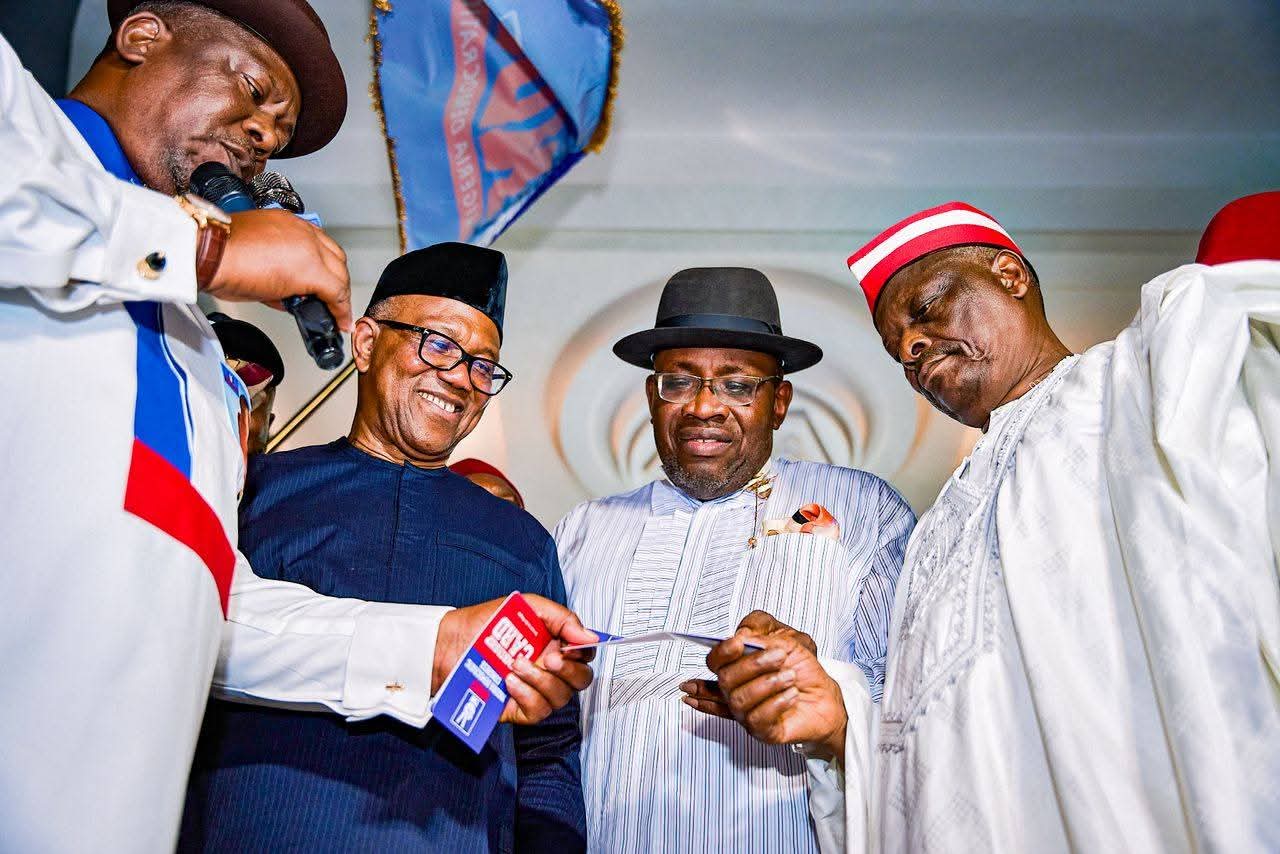
Former presidential candidate, Peter Obi, has stated that the worsening condition of Nigeria and the urgent need to “rescue the nation” informed his decision to leave the African Democratic Congress (ADC) for the Nigerian Democratic Congress (NDC).
In a detailed statement released after his formal defection, Obi confirmed that he joined the NDC alongside former Kano State governor, Rabiu Musa Kwankwaso, describing the move as a continuation of a long-standing struggle to build a nation anchored on justice, competence, accountability, and compassion for ordinary Nigerians.
Obi stressed that his decision was neither driven by personal ambition nor political convenience, but by deep reflection on Nigeria’s current trajectory. He warned that the country is heading down a “dangerous path,” citing rising poverty, widespread hunger, insecurity, and declining economic stability as urgent concerns demanding decisive leadership.
The former Anambra State governor reiterated his long-held belief that politics must prioritise the welfare of citizens over personal gains, lamenting that millions of Nigerians can no longer afford basic necessities, while businesses continue to collapse and hope diminishes among the youth.
Explaining his exit from the ADC, Obi pointed to what he described as “severe, orchestrated litigation and internal crises” aimed at frustrating the participation of credible actors in the democratic process. He noted that similar challenges influenced his earlier departure from the Labour Party.
Despite his exit, Obi expressed gratitude to the ADC leadership, particularly its National Chairman, David Mark, for what he called exemplary leadership. He also acknowledged former Vice President, Atiku Abubakar, describing him as a respected leader and elder brother.
Obi used the opportunity to caution against the alleged manipulation of political structures through unresolved litigations and internal destabilisation. He warned that weakening opposition parties undermines democratic balance and ultimately harms the Nigerian people.
According to him, democracy must not be weaponised, but should instead provide a level playing field where citizens can freely make choices without fear, intimidation, or interference.
He further painted a grim picture of Nigeria’s current state, noting that economic hardship, insecurity, and institutional decline have eroded public trust. Obi argued that leadership at such a critical time must be defined by competence, capacity, character, and compassion, rather than propaganda or divisive politics.
Describing the move to the NDC as a continuation rather than a departure from his principles, Obi said the mission remains to build a Nigeria where leadership is service-driven, institutions function independently, and every citizen can live with dignity, security, and hope.
He called on Nigerians across political, ethnic, and religious divides to unite in pursuit of national renewal, emphasising that the task ahead transcends individual ambitions or party affiliations.
Obi concluded by appreciating Nigerians—especially youths and women—for their resilience, urging them not to lose faith in the country.
“A new Nigeria is still possible,” he affirmed.


