

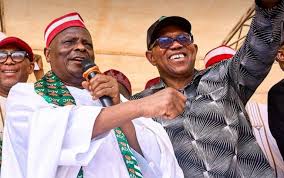
In a development that could reshape Nigeria’s political landscape ahead of future elections, Peter Obi, the 2023 presidential candidate of the Labour Party, and Rabiu Kwankwaso, former governor of Kano State, have formally joined the Nigeria Democratic Congress (NDC).
The announcement, confirmed by party officials on Sunday, signals a significant realignment within Nigeria’s opposition politics, bringing together two influential figures with substantial grassroots support across different regions of the country. Observers say the move could mark the beginning of a broader coalition aimed at challenging the dominance of the country’s traditional political blocs.
Peter Obi, widely regarded for his strong performance in the 2023 presidential election and his appeal among young and urban voters, described his decision as “a step toward building a more united and purpose-driven political front.” He emphasized the need for collaboration over fragmentation, noting that Nigeria’s pressing economic and governance challenges require “collective action anchored on competence, integrity, and accountability.”
Similarly, Rabiu Kwankwaso, a seasoned political figure with deep influence in northern Nigeria, framed his move as a strategic effort to strengthen democratic alternatives. Known for his Kwankwasiyya movement, Kwankwaso stated that joining the NDC would provide “a broader platform to pursue inclusive governance and national development.”
The NDC, though relatively new in Nigeria’s political space, has been positioning itself as a reform-oriented party seeking to attract credible leaders and dissatisfied members from existing parties. Party leadership welcomed the duo, describing their entry as “a historic moment” that reinforces the party’s commitment to national unity and progressive governance.
Political analysts suggest that the convergence of Obi and Kwankwaso under one platform could significantly alter voter dynamics, particularly if it leads to further defections or alliances. Their combined influence spans key voting blocs—Obi’s strong base in the South-East and parts of the South-South, and Kwankwaso’s entrenched support in the North-West.
However, questions remain about how seamlessly their political structures and ideologies will integrate within the NDC framework. Past coalition efforts in Nigeria have often struggled with internal divisions, power-sharing disagreements, and conflicting ambitions.
Despite these concerns, supporters of the move view it as a bold attempt to redefine opposition politics in Nigeria. Many believe that if effectively managed, the alliance could offer a formidable alternative capable of reshaping the country’s democratic trajectory.
As the political landscape continues to evolve, all eyes will be on how the NDC leverages this high-profile development and whether it can translate momentum into a cohesive and viable national movement.


