

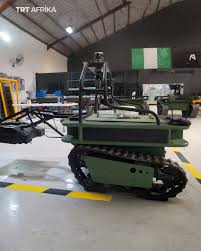
A Nigerian defense technology firm, Terra Industries, has unveiled a suite of autonomous systems designed to combat insurgency and enhance military operations, marking a significant step in the country’s push for indigenous security solutions.
The company showcased its innovations on Monday at its Abuja facility, where its Chief Executive Officer, Nathan Nwachukwu, presented a range of technologies including interceptor drones, mine-clearing unmanned ground vehicles, and battlefield intelligence software.
According to Nwachukwu, the systems are tailored to address Nigeria’s evolving security challenges, particularly the threats posed by insurgent groups such as Boko Haram and armed bandits who increasingly deploy drones and improvised explosive devices (IEDs) in attacks.
“These technologies are about building sovereign defense capabilities,” he said, emphasizing the need for locally developed solutions to reduce reliance on foreign military hardware.
One of the standout innovations demonstrated was an unmanned ground vehicle capable of detecting and clearing landmines and roadside bombs—tools that have been widely used in attacks against both civilians and military personnel. The interceptor drones, on the other hand, are designed to identify and neutralize hostile aerial threats, including low-cost drones increasingly used in asymmetric warfare.
Also present at the demonstration was Babatunde Alaya of the Defence Industries Corporation of Nigeria (DICON), who commended the startup’s efforts. He described the technologies as timely interventions capable of reducing troop casualties and improving operational efficiency on the battlefield.
Alaya further announced that, through a partnership between DICON and Terra Industries, the systems are expected to be deployed to frontline operations, signaling a move toward integrating advanced technology into Nigeria’s military strategy.
Nigeria has battled insurgency for over 17 years, particularly in the North-East, where attacks by extremist groups have led to widespread displacement, loss of lives, and destruction of infrastructure. The increasing sophistication of these groups, including their use of drones and explosives, has intensified the need for modern countermeasures.
The startup has reportedly secured $34 million in funding to scale its operations, with backing that includes investment linked to Joe Lonsdale. Industry observers say this level of support reflects growing global interest in African defense innovation.
Security analysts note that the introduction of such technologies could reshape Nigeria’s counterinsurgency approach, shifting from traditional manpower-heavy operations to more intelligence-driven and automated systems.
However, they also caution that successful deployment will depend on proper training, maintenance, and integration with existing military structures.
The unveiling of these systems highlights a broader trend toward technological adaptation in modern warfare and underscores Nigeria’s ambition to develop homegrown solutions to its security challenges.
As the country continues to grapple with insurgency and banditry, innovations like those from Terra Industries may play a critical role in redefining how security operations are conducted—potentially offering new hope in a long-standing conflict.


