

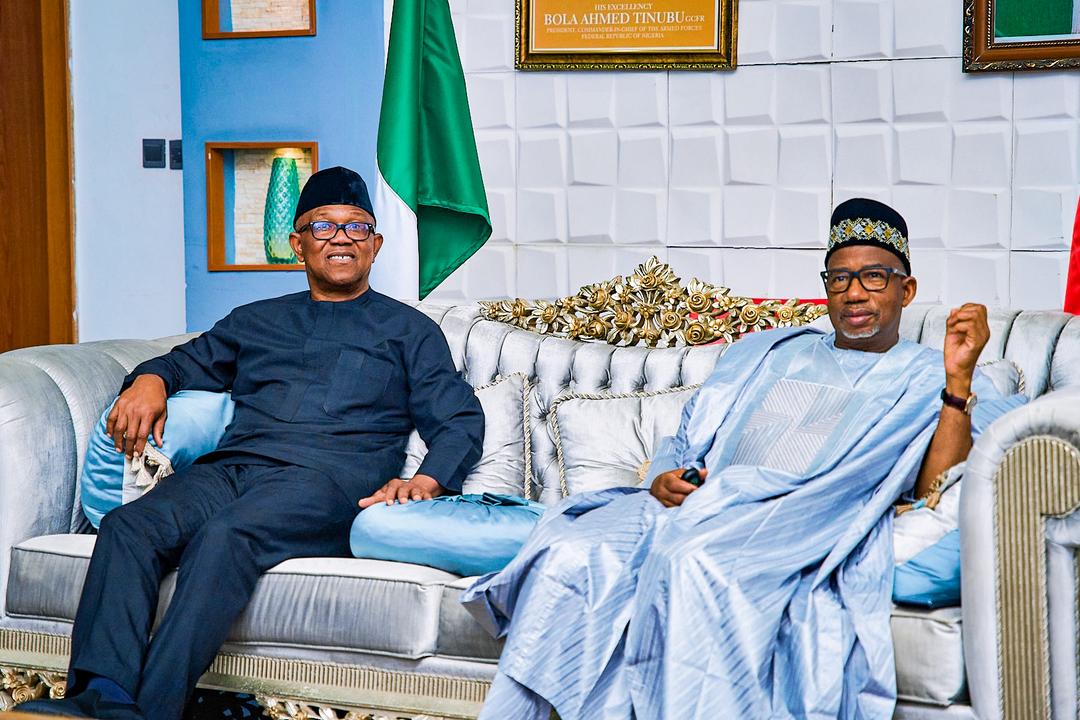
Former presidential candidate Peter Obi has intensified efforts to build a broad opposition alliance ahead of the 2027 general elections, following a strategic meeting with Bala Mohammed in Bauchi.
Obi, who recently aligned with the African Democratic Congress (ADC) after departing the Labour Party, used the visit to rally support from key stakeholders in Nigeria’s North-East region. The meeting is widely seen as part of a broader strategy to consolidate opposition forces and challenge the dominance of the ruling All Progressives Congress (APC).
During the discussions, both Obi and Governor Mohammed emphasized the importance of national unity and cross-party collaboration, signaling a willingness to move beyond rigid political affiliations in pursuit of what they described as a better future for Nigeria.
Sources familiar with the meeting indicated that the talks focused on strengthening cooperation among opposition leaders, particularly in regions considered politically strategic for the 2027 elections. The North-East, with its complex political dynamics and growing voter base, is seen as a key battleground.
Observers say Obi’s outreach to leaders like Bala Mohammed reflects a deliberate attempt to build a coalition capable of mounting a formidable challenge to the APC. In Nigeria’s political landscape, alliances and regional partnerships often play a decisive role in determining electoral outcomes.
Following the meeting, Obi engaged with local communities, where he demonstrated his continued focus on social intervention. He awarded scholarships worth N5 million to students at a local Islamic school, underscoring his commitment to education and youth development.
In addition, he pledged medical assistance to a student affected by insecurity, a gesture that resonated with many residents in the region, where security challenges have significantly impacted livelihoods and access to basic services.
Supporters of Obi have hailed the visit as evidence of his growing national appeal and his willingness to engage across regional and religious lines. They argue that such engagements are crucial for fostering unity in a country often divided along ethnic and political boundaries.
Critics, however, view the move as part of early campaign positioning, noting that political outreach of this nature is common in the lead-up to elections. They also question whether opposition leaders can sustain unity given historical rivalries and competing ambitions.
Political analysts suggest that the success of any opposition coalition will depend not only on high-level meetings but also on the ability to translate agreements into a coherent political structure with clear leadership and policy direction.
“Building a coalition is one thing; maintaining it is another,” an analyst remarked. “The real test will be how these alliances evolve over time.”
As the 2027 elections approach, Nigeria’s political landscape continues to shift, with realignments, defections, and coalition-building shaping the emerging contest.
For Obi, the Bauchi meeting represents another step in his effort to expand his influence beyond traditional support bases and position himself as a unifying figure capable of bridging regional divides.
Whether these efforts will translate into electoral success remains uncertain, but the message from the meeting is clear: the race for 2027 is already taking shape, and opposition forces are beginning to organize for what promises to be a highly competitive political battle.


