

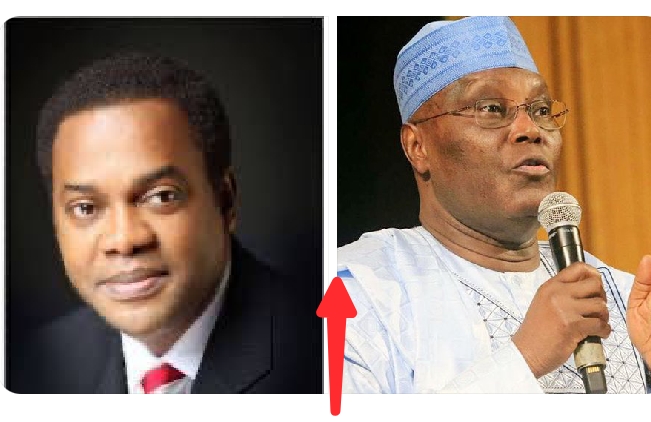
Former Cross River State governor, Donald Duke, has delivered a pointed message to former Vice President, Atiku Abubakar, urging him to abandon his long-standing presidential ambition ahead of the 2027 elections.
Duke argued that Nigeria’s fragile political balance—particularly the sensitive issue of regional power rotation—must be respected, even by those not fully committed to zoning. He questioned the logic of returning power to the North so soon after a northern presidency, warning that such a move could deepen national divisions and weaken trust in the system.
According to him, after eight years of northern leadership, it would be difficult to justify supporting another northerner after only four years of a southern presidency. He framed the issue not just as political strategy, but as a matter of fairness and national cohesion.
In a direct appeal, Duke advised Atiku to “step aside” and embrace the role of a kingmaker—leveraging his vast political experience and network to support and mentor a new generation of leaders, rather than pursuing the presidency yet again.
The remarks add to the growing debate within opposition circles over zoning, generational shift, and the strategic direction of coalition politics ahead of 2027.
Donald Duke’s remarks go beyond a personal critique of Atiku Abubakar—they tap into some of the deepest fault lines in Nigeria’s political structure: zoning, generational transition, and electoral strategy.
At the heart of his argument is the principle of rotational presidency, an informal but powerful convention designed to maintain balance between the North and South. While not enshrined in law, it has shaped political expectations since the return to democracy in 1999. Duke is essentially warning that ignoring this balance—especially so soon after a northern presidency—could be politically destabilizing.
The Zoning Dilemma
Duke openly admits he is not a strong advocate of zoning as a rigid rule. However, he recognizes its practical importance in holding the country together. His concern is less about ideology and more about perception and legitimacy.
After eight years of northern leadership under Muhammadu Buhari, the expectation in many quarters was that power should rotate South. With Bola Ahmed Tinubu currently serving, Duke argues that pushing for another northern candidate—particularly one as prominent as Atiku—after just one southern term risks:
Reinforcing feelings of marginalization in the South
Weakening trust in informal power-sharing agreements
Creating avoidable political tension ahead of 2027
His rhetorical question—“How do I explain this to my children?”—is meant to simplify a complex national issue into a moral one: fairness.
“Doing the Same Thing” — A Strategic Critique
Duke’s comment about repeating the same approach speaks to Atiku’s persistent presidential bids over the years. The underlying message is that:
Atiku’s electoral formula has been tested multiple times without success
The political landscape has changed—youth participation, digital mobilization, and anti-establishment sentiment are stronger now
A fresh face might be more effective in rallying a broader coalition
This is less an attack on Atiku’s capability and more a critique of political fatigue—the idea that voters may be looking for something new.
King vs Kingmaker
Perhaps the most strategic part of Duke’s statement is the call for Atiku to transition into a kingmaker role.
In Nigerian politics, kingmakers often wield enormous influence behind the scenes. Duke is essentially suggesting that Atiku’s legacy could be stronger if he:
Backs a younger or more broadly acceptable candidate
Helps unify fragmented opposition blocs
Uses his political structure and experience to shape outcomes indirectly
Rather than another personal bid, this approach could position Atiku as a consensus builder, someone who finally helps the opposition overcome its internal divisions.
The Generational Undercurrent
Duke’s remarks also quietly align with a broader shift—especially visible among Gen Z voters (like those recently turning out en masse for PVC registration in Abuja). There is a growing demand for:
New leadership faces
Different political messaging
Greater accountability and innovation
Atiku, fairly or not, is often seen as part of the old political order, and Duke appears to be signaling that the moment may call for a transition.
The Bigger Political Message
Ultimately, Duke’s intervention is about strategy and optics:
Winning elections in Nigeria is not just about structure, but also narrative and timing
The opposition risks weakening itself if it ignores public sentiment on zoning and renewal
A divided or tone-deaf approach could inadvertently strengthen incumbents
So, Duke isn’t just telling Atiku to step down—he’s warning that insisting on the same path could cost the opposition another opportunity in 2027.
If anything, the statement reflects a growing internal conversation: whether Nigeria’s opposition will prioritize individual ambition or collective viability in the next electoral cycle.


