
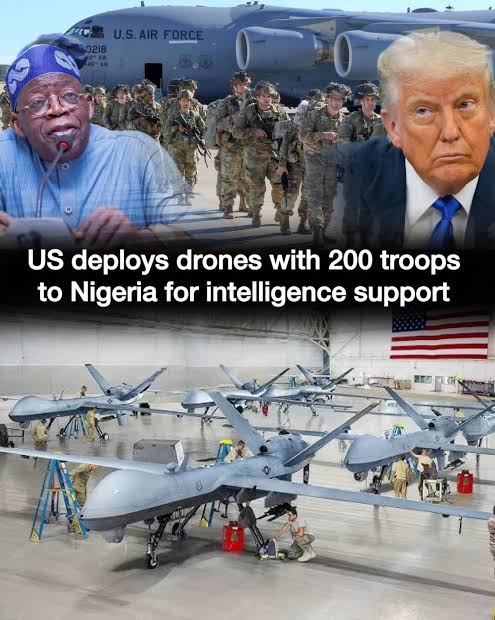
In a significant shift in regional security dynamics, the United States has deployed advanced MQ-9 Reaper drones alongside approximately 200 military personnel to Nigeria, deepening its operational support in the fight against insurgency in the country’s troubled northern region.
According to Nigerian defence authorities, the deployment—confirmed by Major General Samaila Uba—will focus strictly on intelligence gathering, surveillance, and military training. The American troops are not engaged in frontline combat operations but are instead providing critical support through a newly established U.S.-Nigeria intelligence fusion cell. From a strategic airfield in Bauchi, the drones are already delivering actionable intelligence to Nigerian commanders battling extremist groups.
The intervention comes on the heels of a deadly bomb blast in Borno State, underscoring the persistent threat posed by insurgent factions such as Boko Haram and ISWAP. Security experts view the move as a calculated response to rising militant activity, particularly across Nigeria’s northeastern corridor and its porous northwest borders.
The MQ-9 drones—renowned for their endurance and high-altitude surveillance capabilities—can remain airborne for over 27 hours, enabling continuous monitoring of terrorist movements. While capable of precision strikes, officials insist the drones are currently restricted to reconnaissance roles within Nigerian airspace.
This latest development signals a renewed American footprint in West Africa following its 2024 withdrawal from neighbouring Niger, where it previously operated a $100 million drone base. Analysts suggest the relocation of intelligence assets into Nigeria reflects Washington’s evolving counterterrorism priorities amid the spread of Islamic State and Al-Qaeda-linked networks across the Sahel.
A U.S. defence official described the collaboration as a “shared security effort,” noting that the deployment was made at Nigeria’s request. Nigerian authorities echoed this stance, maintaining that all operations remain under national command, with foreign personnel playing strictly supportive roles.
Despite previous U.S. airstrikes in northwest Nigeria in late 2025, the current arrangement stops short of direct combat involvement. However, it reinforces a growing military partnership between Washington and Abuja under President Bola Ahmed Tinubu’s administration.
As insurgents continue to stage opportunistic and high-visibility attacks, both nations appear poised to strengthen intelligence-driven operations aimed at dismantling terror networks and restoring stability across affected regions.
BREAKING: U.S. Deploys Armed Drones, Troops to Nigeria After Borno Bombing Escalation

- Advertisement -

