

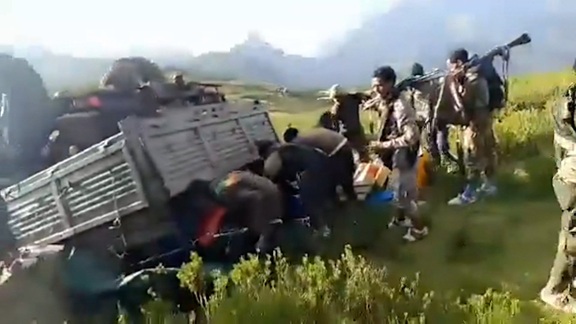
Fresh fighting between Ethiopian federal forces and fighters aligned with the Tigray People’s Liberation Front has renewed fears that Ethiopia could slide back into a wider civil war, less than four years after a peace agreement ended a devastating conflict in the country’s north.
The latest escalation began around September 22 and has spread beyond Tigray into parts of the neighbouring Amhara and Afar regions. Both sides have accused the other of triggering the latest hostilities, making it difficult to independently establish responsibility for individual attacks and territorial changes.
The renewed violence comes after years of fragile peace following the two-year Tigray war, which began in November 2020. The conflict involved Ethiopian federal troops, Eritrean forces, Amhara fighters and Tigrayan forces. It resulted in hundreds of thousands of deaths, displaced millions of people and left much of Tigray isolated from the outside world.
A peace agreement signed in Pretoria, South Africa, in November 2022 brought an end to the full-scale fighting. However, several of the disputes that contributed to the war remained unresolved, including the status of western Tigray and the return of displaced residents.
One of the most significant developments preceding the latest fighting was the formation of a new alliance involving seven armed groups opposed to Prime Minister Abiy Ahmed’s government.
The Ethiopian Peoples’ Forces Alliance for Survival includes the TPLF, the Amhara Fano National Movement and the Oromo Liberation Army, as well as groups from other parts of the country. The alliance says its objective is to remove Abiy’s government.
The alliance has brought together former adversaries. TPLF forces and Amhara Fano fighters fought on opposite sides during the 2020–2022 war, but they are now part of the same broader coalition against the federal government.
Despite their common opposition to Abiy, the groups have differing political objectives and unresolved territorial disputes. Analysts have therefore questioned how effectively the alliance can operate as a unified force.
The latest fighting has also raised concerns about Ethiopia’s relationship with neighbouring Eritrea. Ethiopian authorities have accused Eritrea of supporting armed groups seeking to weaken the federal government. Eritrea has repeatedly denied such accusations. Ethiopia and Eritrea fought on the same side during the previous Tigray conflict, but relations between the two countries have deteriorated since then.
On the ground, Tigrayan forces have reportedly taken control of airports in Mekelle, Axum and Shire, disrupting civilian air travel. Fighting has also been reported around border areas, while Ethiopia’s military has reported operations against armed groups in Amhara. Some battlefield claims remain difficult to independently verify.
The humanitarian implications are already causing concern. Human Rights Watch warned that renewed hostilities could expose civilians to further abuses, citing the record of atrocities committed during the previous conflict. Tigray also continues to deal with displacement from the earlier war, with hundreds of thousands of people still displaced before the latest escalation.
The African Union has called for an immediate halt to the escalation and renewed dialogue under the Pretoria agreement. It has also asked former Nigerian President Olusegun Obasanjo, who played a role in mediating the 2022 peace deal, to engage the parties urgently.
The Intergovernmental Authority on Development has similarly urged countries in the region to avoid actions that could further intensify the crisis.
For now, analysts cited by Al Jazeera say Ethiopia has not yet entered another full-scale civil war. However, the spread of fighting beyond Tigray, the emergence of a multi-group armed alliance and worsening tensions involving Eritrea have increased concerns that the conflict could become broader if diplomatic efforts fail.


