

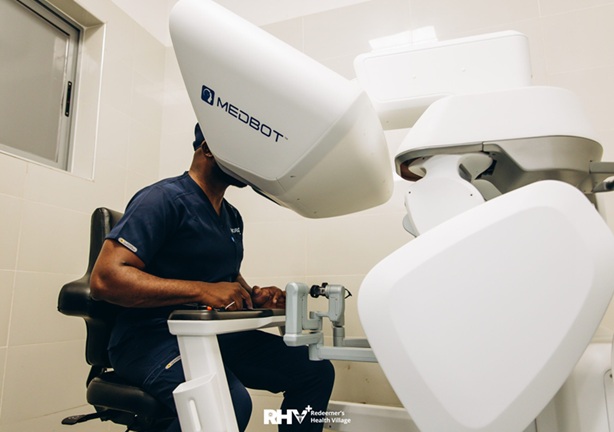
Nigeria’s healthcare sector has recorded a significant technological development with the emergence of robotic-assisted and tele-robotic surgery at Redeemer’s Health Village in Redemption City, Mowe, Ogun State.
The facility recently performed a series of robotic procedures, including a landmark operation in which surgeons in Ogun State remotely operated on a patient in Abuja, about 500 kilometres away. The procedure involved the removal of a cancerous tumour from the patient’s kidney.
The tele-robotic operation was carried out in collaboration with RoboMed Global Inc. and Nisa Premier Hospital in Abuja. The surgical robot at the Abuja facility was connected through the internet to a robotic control system at Redeemer’s Health Village, allowing specialists in Ogun State to control the instruments remotely.
The development has been described by the hospital as a major step towards expanding access to highly specialised surgical care in Nigeria and West Africa.
Chief Executive Officer of Redeemer’s Health Village, Dr Adedamola Dada, said the facility wanted robotic surgery to become a routine part of its medical services rather than a one-off technological demonstration.
According to him, the hospital’s objective is to provide world-class healthcare that remains accessible and affordable to Nigerians, regardless of their religion, ethnicity, state of origin or social background.
Robotic-assisted surgery differs from conventional surgery because the surgeon operates specialised robotic instruments from a control console. The technology can provide magnified visualisation and allow highly precise movements, including movements beyond the natural range of the human wrist.
Medical experts involved in the programme said the technology could reduce the size of surgical incisions, minimise tissue damage and potentially reduce blood loss and postoperative discomfort. They also said some patients could leave the hospital sooner following appropriate procedures.
The development followed the facility’s first robotic-assisted prostate cancer surgery, performed on a middle-aged man. The operation was conducted by urology specialists, the hospital’s medical team and robotic surgeons from RoboMed Global Inc.
One of the patients, Pastor Alexander Idachama, subsequently described his experience after undergoing a robotic-assisted radical prostatectomy at the facility. He said the treatment saved him the cost and inconvenience of travelling abroad for medical care and that he was discharged less than 24 hours after the procedure.
Idachama said he experienced some pain after the operation but that it subsided quickly. He described the robotic equipment as world-class and said he would recommend the facility to others.
Beyond robotic surgery, Redeemer’s Health Village has established itself as a heavily equipped tertiary medical facility. Dada said the hospital has five operating theatre suites and provides services including joint replacement, neurosurgery and complex orthopaedic procedures.
The hospital also has a substantial intensive-care capacity, including a 16-bed adult intensive care unit and a neonatal intensive care unit with almost 20 beds. Its radiology department is another major component of its medical infrastructure.
The facility is also preparing to expand its role in medical education. Dada disclosed that it had received accreditation from the National Universities Commission in conjunction with Redeemer’s University and was working towards commencing a medical school.
The recent developments come against the backdrop of Nigeria’s long-standing challenge of medical tourism, where patients travel abroad to access specialised procedures that are unavailable or difficult to obtain locally.
The introduction of robotic and tele-robotic surgery could help address part of that challenge if the technology becomes sufficiently available and affordable. It could also allow specialists outside Nigeria to participate remotely in complex procedures without requiring patients to travel.
However, sustaining such advanced healthcare services will require reliable telecommunications infrastructure, specialist training, equipment maintenance and investment in medical research and personnel.
For Redeemer’s Health Village, the immediate ambition is to move beyond isolated demonstrations and make robotic surgery part of routine healthcare delivery.
The successful operation between Ogun State and Abuja has consequently placed Nigeria among countries exploring how surgical robotics and telecommunications can overcome geographical barriers and expand access to specialised medical care.


