

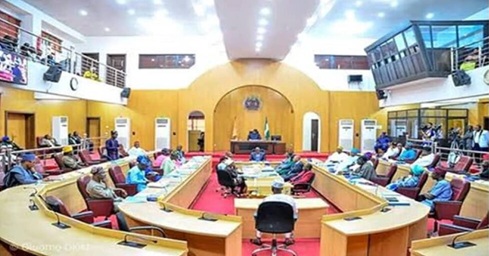
The Osun State chapter of the All Progressives Congress and the state House of Assembly have disagreed over the constitutionality of a newly passed bill seeking to regulate motor parks and commercial transport activities across the state.
The Osun State Integrated Transport, Traffic and Park Management System Bill, 2026, was passed by the House of Assembly on Wednesday following deliberations and consideration of a committee report.
The legislation provides for the registration, regulation, management and digital administration of commercial transportation, traffic, motor parks, terminals, garages, loading points and related transport infrastructure in the state. One of its key provisions is the introduction of a digitalised ticketing system aimed at eliminating multiple ticketing and improving transparency in revenue collection.
However, the Osun APC rejected the legislation on Thursday, describing it as unconstitutional and calling for its withdrawal.
In a statement signed by the party’s spokesperson, Kola Olabisi, the APC argued that the state House of Assembly lacked the constitutional authority to directly regulate and manage motor parks.
The party based its argument on Section 7(1) of the 1999 Constitution, read alongside the Fourth Schedule, which lists the establishment, maintenance and regulation of motor parks among the functions of local government councils.
The APC argued that transferring direct control and revenue collection from motor parks to the state government would conflict with those constitutional provisions. It also described the bill as capable of generating conflict and urged the lawmakers to withdraw it.
The party’s objection comes against the backdrop of recent disputes over the control of motor parks in Osun.
Earlier in September, Governor Ademola Adeleke ordered the vacation of motor parks by rival groups following the killing of his political associate and Accord Party chieftain, Olalekan Oyeyemi, popularly known as Emir Ajagungbade, at Mayfair Motor Park in Ile-Ife.
The governor subsequently announced plans to establish a new park management structure, while the Assembly moved to provide legislative backing for the system.
The House of Assembly, however, rejected the APC’s interpretation of the Constitution.
In a statement signed by Olamide Tiamiyu, Chief Press Secretary to the Speaker, Adewale Egbedun, the legislature accused the APC of selectively interpreting Section 7 of the Constitution.
The Assembly acknowledged that the Fourth Schedule assigns the regulation of motor parks to local government councils but argued that the constitutional framework must be read together with provisions governing the relationship between state and local governments.
According to the lawmakers, Section 7(1) requires state governments to ensure the existence of democratically elected local governments under laws providing for their establishment, structure, composition, finance and functions.
The Assembly further argued that the Constitution recognises the authority of state Houses of Assembly to confer functions on local government councils through legislation.
It also cited Section 100 of the Constitution, which sets out the procedure through which the legislative powers of a state House of Assembly are exercised, including the passage of bills and their subsequent assent by the governor.
The lawmakers therefore maintained that the bill had passed through the required legislative process, including committee scrutiny, debate and third reading.
The Assembly also rejected the APC’s description of the legislation as a recipe for crisis, saying the bill was intended to promote order, transparency, passenger protection and safety within the transport sector.
It said the proposed digital ticketing system was designed to reduce multiple ticketing, while a coordinated management structure would improve accountability in the collection and administration of transport-related revenue.
The Assembly challenged the APC to approach a competent court if it believed the legislation violated the Constitution rather than attempting to determine its validity through public statements.
The disagreement now places the bill’s constitutional basis at the centre of a wider debate over the respective responsibilities of state and local governments in managing motor parks.
The legislation will be forwarded to Governor Adeleke for assent following its passage. Whether the controversy is resolved through further legislative engagement, executive action or judicial interpretation remains to be seen.


