

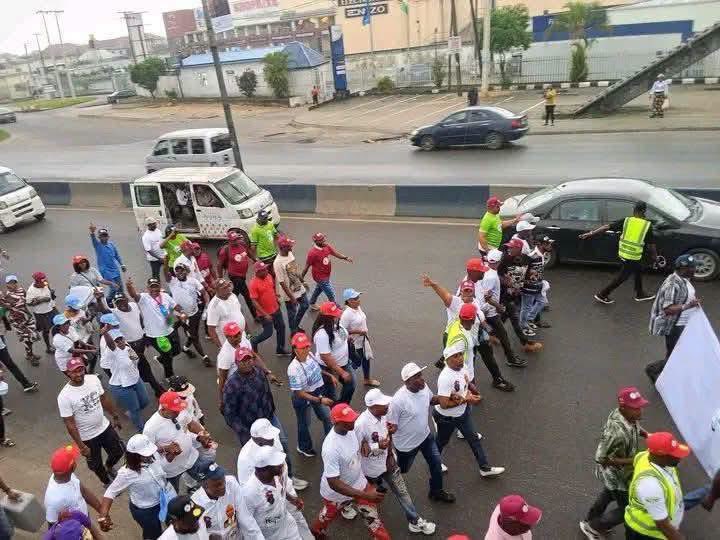
PORT HARCOURT — A purported One Million-Man March in support of President Bola Ahmed Tinubu in Rivers State has become the subject of widespread ridicule after a viral social-media post claimed that only 52 men and one woman turned up for the event.

The organisers had reportedly promised a massive demonstration of support for President Tinubu and the ruling APC. However, images and videos circulating online painted a sharply different picture, prompting Nigerians on social media to question the strength of the party’s grassroots mobilisation in the state.
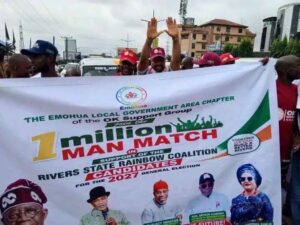
The claim that exactly 52 men and one woman attended has not been independently verified, and should therefore be treated as a social-media allegation rather than an established fact. Similar claims are circulating primarily through social-media posts.
The development has nevertheless generated a wave of humour and political commentary, with critics describing the alleged turnout as a symbolic “receipt” from Rivers people to the APC.
“They promised a One Million-Man March. What showed up was a crowd small enough to count without a calculator,” one commentator joked.
Political rallies have increasingly become a battleground for perceptions ahead of the 2027 general elections, with competing political groups using crowd sizes and public demonstrations to project popularity. Previous reports have documented large APC/Tinubu support marches in Rivers and other states, making the authenticity and timing of every viral rally video particularly important to verify.
REPORT: The Growing Signs of Public Discontent With Tinubu’s Administration
The sparse turnout reportedly recorded at the much-publicised pro-Tinubu march in Rivers State may be politically symbolic, but one event alone cannot prove that President Bola Ahmed Tinubu has been rejected by all Nigerians. The broader picture, however, is that there is substantial and well-documented public dissatisfaction with his administration as Nigeria moves closer to the 2027 general elections.
The question confronting the President is no longer simply whether his government has introduced reforms. It is whether ordinary Nigerians can feel the benefits of those reforms in their homes, businesses and communities.
Economic hardship has become the loudest political protest
For millions of Nigerians, the promise of Renewed Hope has collided with the reality of rising living costs. The removal of fuel subsidies and other economic reforms may have won praise from investors and international economic observers, but many households continue to struggle with food, transportation, rent and basic necessities. Reuters recently reported widespread economic distress and cited polling showing that a large majority of Nigerians believe the country is moving in the wrong direction.
This is where the political disconnect becomes most visible: government officials may speak about macroeconomic recovery, but Nigerians judge government by what happens at the market, in their kitchens and in their pockets.
A government cannot continually ask hungry citizens to celebrate statistics while their purchasing power is shrinking.
Insecurity continues to undermine public confidence
Security is another major source of frustration. Kidnappings, attacks and mass abductions remain a frightening reality in several parts of the country. Recent reporting has highlighted both the scale of the kidnapping crisis and serious concerns about the ability of security agencies to protect vulnerable communities.
For citizens who cannot travel safely, farm safely or send their children to school without fear, political promises increasingly sound disconnected from reality. Security is not an abstract campaign issue—it is about whether Nigerians can stay alive and live freely.
The “rejection” is reflected in declining confidence—not necessarily unanimity
Political opponents have pointed to approval surveys as evidence of declining confidence in the President, although their interpretations should be distinguished from independently verified election results. One survey reported by Channels Television placed Tinubu’s approval at around 30 percent after three years in office, while opposition parties argued that worsening living conditions were driving dissatisfaction.
The important political point is this: rejection does not mean every Nigerian has abandoned Tinubu. He retains supporters, a powerful political party and significant institutional advantages. But widespread dissatisfaction represents a serious warning sign that cannot simply be dismissed as opposition propaganda. Reuters has similarly reported that economic hardship and insecurity are creating significant voter dissatisfaction as the political contest approaches.
Rivers May Be a Symbol of a Bigger Political Problem
If the reported poor turnout at the Rivers march accurately reflects the mood surrounding the event, then the embarrassment is not merely about numbers. It raises a more fundamental question: Where are the ordinary Nigerians who are supposed to be passionately defending the government’s record?
Political support cannot always be manufactured through banners, rented crowds, elite endorsements or carefully organised ceremonies. Genuine popularity announces itself through spontaneous public enthusiasm.
As Nigeria approaches 2027, Nigerians are increasingly likely to ask difficult questions:
- Has life improved since 2023?
- Are Nigerians safer today?
- Can families afford basic necessities?
- Are young people seeing more opportunities?
- Has government restored hope—or merely asked citizens to endure longer?
These questions will be answered not at press conferences, but ultimately at the ballot box.
The Verdict Belongs to the People
It would be premature to declare the outcome of the 2027 election today. Nigerian politics remains unpredictable, and dissatisfaction with an incumbent does not automatically translate into electoral victory for the opposition. But the growing frustration over hardship, insecurity and declining confidence is unmistakably becoming a central political challenge for the Tinubu administration.
The message from the streets is becoming increasingly difficult to ignore: Nigerians want more than promises. They want results.
And if the government fails to translate its promises into improvements in the lives of ordinary citizens, 2027 may become the moment Nigerians use the most powerful weapon democracy gives them—their vote—to demand a different direction.
For now, the viral moment has delivered one clear political message online: promises of millions mean little when the cameras begin to count the people on the ground.


