

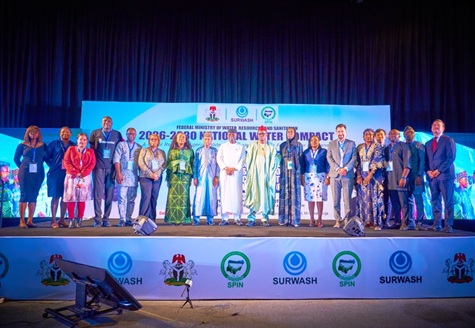
The Federal Ministry of Water Resources and Sanitation has unveiled the first draft of the 2026–2030 National Water Compact, a strategic framework designed to address some of the most pressing challenges confronting Nigeria’s water and sanitation sector over the next four years.
The ministry said the draft compact is intended to provide a coordinated roadmap for improving access to safe water, strengthening sanitation services and tackling longstanding structural problems affecting the sector.
The document was unveiled as part of ongoing efforts by the Federal Government to reposition Nigeria’s water sector and ensure that more citizens have access to reliable and sustainable water services.
For decades, Nigeria has faced significant challenges in providing safe and affordable water to its rapidly growing population. Many communities continue to depend on boreholes, wells, rivers and other alternative sources, while inadequate infrastructure and poor maintenance have affected the reliability of public water supply systems.
The new National Water Compact is expected to provide a framework for addressing these challenges through stronger coordination among the Federal Government, state governments, development partners, private-sector stakeholders and communities.
The ministry said the draft focuses on the most difficult issues facing the sector and seeks to establish clear priorities for the 2026–2030 period.
Among the broader concerns the compact is expected to address are inadequate water infrastructure, limited access to safely managed sanitation, weak institutional capacity, insufficient financing and the sustainability of existing water systems.
Nigeria’s sanitation challenges have also remained a major public-health concern, particularly in communities where access to toilets and safe waste-disposal systems is limited.
Poor sanitation and unsafe water can increase exposure to waterborne diseases, place additional pressure on healthcare systems and disproportionately affect children and vulnerable households.
The Federal Government’s decision to develop a new multi-year compact therefore reflects an attempt to move from fragmented interventions towards a more coordinated approach to water-sector development.
The ministry is expected to use consultations with relevant stakeholders to refine the draft before its final adoption.
Stakeholder participation will be particularly important because water supply and sanitation responsibilities cut across different levels of government.
While the Federal Government provides national policy direction and supports major projects, state and local governments play crucial roles in the delivery and maintenance of water services at community level.
The private sector and development partners also provide significant technical and financial support for water and sanitation programmes.
Consequently, successful implementation of the National Water Compact will depend not only on the quality of the document but also on the willingness of stakeholders to work within a common framework.
Financing is likely to be one of the biggest challenges.
Water infrastructure requires substantial investment, while existing facilities also need regular maintenance to remain functional. Without sustainable funding mechanisms, new water projects can deteriorate after construction, leaving communities once again without reliable services.
The compact is therefore expected to encourage more effective mobilisation and deployment of resources while improving accountability within the sector.
Another important issue is climate change.
Changing rainfall patterns, flooding, drought and the degradation of water sources are increasingly affecting water security in different parts of Nigeria. A long-term national water strategy must therefore account for climate resilience and the sustainable management of water resources.
The draft compact could provide an opportunity to integrate these considerations into national planning.
It also comes at a time when Nigeria is facing rapid population growth and urbanisation. As cities expand, demand for clean water and effective sanitation services is expected to increase significantly.
Without major improvements in infrastructure and management, existing water systems could come under even greater pressure.
The ministry’s initiative therefore carries implications far beyond the water sector itself.
Reliable access to safe water can improve public health, support education, enhance productivity and reduce the burden on households—particularly women and children who often bear the responsibility of fetching water in communities without reliable supply.
However, the success of the 2026–2030 National Water Compact will ultimately be measured by its impact on ordinary Nigerians.
A well-designed strategy will need to translate into functioning water systems, improved sanitation facilities, stronger institutions and measurable increases in access to safe water.
The unveiling of the first draft marks the beginning rather than the conclusion of that process.
The Federal Ministry of Water Resources and Sanitation will now face the task of incorporating stakeholder feedback, establishing realistic targets and ensuring that the final compact is supported by the resources and institutional arrangements required for implementation.
If successfully executed, the 2026–2030 National Water Compact could provide Nigeria with a more coherent strategy for tackling its longstanding water and sanitation challenges.
For millions of Nigerians who still struggle to obtain safe and reliable water, however, the ultimate expectation is simple: that the promises contained in the policy document will eventually translate into water flowing from functional taps and safer sanitation facilities in their communities.


