

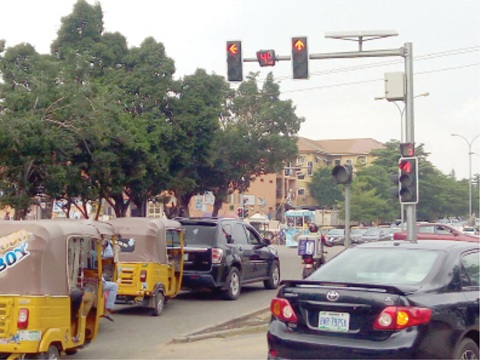
Residents, motorists, passengers, business owners and traffic officials in parts of Abuja have raised concerns over the persistent failure of traffic lights at several busy junctions, warning that the situation is creating confusion, causing delays and increasing the risk of road crashes.
The malfunctioning traffic signals have reportedly left motorists to rely heavily on manual directions, personal judgement and informal right-of-way arrangements, particularly during peak periods when traffic volumes increase significantly.
Some of the affected junctions have become points of congestion as drivers approach intersections without functioning signals. Motorists travelling in different directions are often forced to negotiate who should proceed first, creating uncertainty and increasing the possibility of collisions.
For commuters and passengers, the situation has resulted in longer travel times, particularly during the morning and evening rush hours.
Business owners operating around some of the affected locations have also expressed concern that prolonged traffic congestion could discourage customers and affect the movement of goods.
The situation is particularly worrying in Abuja, where several major roads converge at heavily trafficked intersections. The Federal Capital Territory’s road network carries thousands of vehicles every day, including private cars, commercial buses, taxis and heavy-duty vehicles.
Traffic lights are designed to regulate the movement of these vehicles and pedestrians by establishing predictable right-of-way patterns. When the systems fail, that predictability is disrupted.
A motorist who spoke about the situation described faulty traffic lights as more than an inconvenience, noting that drivers approaching an intersection are sometimes unsure whether to stop or proceed.
Another road user said the problem becomes worse at night when visibility is reduced and some intersections lack adequate alternative lighting or clear signage.
The failure of traffic signals has also placed additional pressure on traffic management officials.
Traffic personnel deployed to some busy junctions have had to manually direct motorists to prevent gridlock and reduce the risk of accidents.
However, manual traffic control may not always be sufficient, especially at large intersections with multiple lanes and high traffic volumes.
Officials can also become overwhelmed during periods of heavy traffic, leaving some motorists to make decisions without clear guidance.
The concerns have consequently renewed calls for the relevant authorities to urgently inspect and repair malfunctioning traffic lights across the Federal Capital Territory.
Residents argue that maintaining traffic-control infrastructure should be treated as an essential component of road safety rather than a secondary issue.
Traffic lights require regular maintenance, reliable power supply, functioning control systems and prompt repairs when faults occur. Delays in addressing minor technical problems can eventually turn them into persistent hazards.
The problem also raises questions about the maintenance arrangements for traffic infrastructure in the capital.
Authorities may need to conduct a comprehensive audit of traffic signals across Abuja to determine how many are currently operational, identify recurring faults and establish a rapid-response system for repairs.
Technology could also play a role in improving the reliability of the system.
Modern traffic-management networks can incorporate remote monitoring, allowing authorities to detect malfunctioning signals and respond before the problem causes major congestion or accidents.
Such systems can also provide traffic officials with real-time information about congestion levels and enable more efficient management of road networks.
For Abuja’s growing population, reliable traffic management is increasingly important.
The Federal Capital Territory continues to experience rapid development, with expanding residential districts, commercial centres and increasing vehicle ownership placing additional pressure on existing roads.
Without effective traffic-control systems, congestion and road-safety risks are likely to increase.
The failure of traffic lights also affects pedestrians, who depend on properly functioning signals to cross busy roads safely.
At intersections where drivers and pedestrians are uncertain about the right of way, vulnerable road users can face significant danger.
The concerns raised by residents therefore extend beyond delays.
They touch on road safety, urban mobility, economic productivity and the overall quality of life in Nigeria’s capital.
A journey delayed by several minutes at one junction can become significantly longer when multiple intersections are affected. For workers and businesses, those lost hours can translate into economic costs.
The authorities responsible for traffic management will therefore face growing pressure to address the problem.
Immediate repairs to failed signals, deployment of traffic officers where necessary and regular preventive maintenance could provide short-term relief, while a comprehensive upgrade of Abuja’s traffic-management infrastructure could offer a longer-term solution.
Residents are not asking for an elaborate system. They want basic traffic infrastructure to function as intended.
For a capital city that prides itself on planned urban development and modern infrastructure, functioning traffic lights should be considered a basic requirement.
Until the affected signals are repaired, motorists and pedestrians will continue to navigate some of Abuja’s busiest junctions with uncertainty.
And every day that the problem persists, residents fear, the risk remains the same: more congestion, more frustration and a greater possibility of preventable road crashes.