

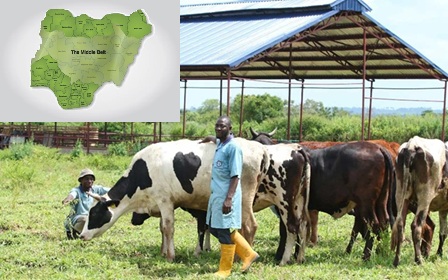
The Southern and Middle Belt Leaders Forum has rejected the Federal Government’s proposed pilot ranching scheme, accusing the government of attempting to take over ancestral lands under the guise of developing Nigeria’s livestock industry.
The forum, which comprises prominent leaders from the Southern and Middle Belt regions, expressed its opposition in a statement issued on Wednesday and signed by its Chairman, Oba Oladipo Olaitan; President of the Middle Belt Forum, Dr Bitrus Pogu; President-General of Ohanaeze Ndigbo Worldwide, John Azuta-Mbata; and National Chairman of the Pan Niger Delta Forum, Ambassador Godknows Igali.
The leaders said they were particularly concerned about the proposed pilot locations, which include Nasarawa, Plateau, Benue, Southern Kaduna, Taraba and the Federal Capital Territory.
According to the forum, the concentration of the proposed ranching programme in the Middle Belt raises questions about the government’s intentions, particularly given the availability of what it described as large expanses of sparsely populated land in parts of northern Nigeria.
The leaders maintained that they were not opposed to ranching or the modernisation of Nigeria’s livestock sector. Rather, they objected to what they described as an “opaque, coercive and discriminatory” approach to implementing the policy.
They argued that ranching should primarily be a private economic enterprise and that government should not compulsorily acquire community land for the benefit of particular livestock owners under the justification of public interest.
The forum also expressed concern that the proposed policy could eventually result in the establishment of permanent settlement zones for nomadic Fulani herders. It warned that such a development could create fresh demographic and security tensions in communities already affected by years of farmer-herder violence.
The leaders particularly cited the history of killings, displacement and destruction of livelihoods in parts of the Middle Belt, arguing that communities that have suffered from the crisis should not subsequently lose additional ancestral land to government-backed ranching schemes.
The controversy comes as the Federal Government seeks to address Nigeria’s longstanding farmer-herder conflict through a transition from open grazing to modern ranching. Government officials and supporters of the policy have argued that ranching could reduce cattle movement, limit clashes between farmers and herders and improve livestock productivity.
The proposed initiative reportedly targets some of the states most affected by farmer-herder conflicts, including Benue, Plateau, Nasarawa, Kaduna, Adamawa and the FCT, with the Wase Grazing Reserve in Plateau State identified as a pilot model.
However, opposition to the policy is growing in some of the affected states. Earlier, the Middle Belt Forum had also rejected the Federal Government’s renewed ranching proposal, while political and community leaders in Benue questioned why public funds should be used to establish ranches for individual livestock businesses.
The Southern and Middle Belt Leaders Forum further raised legal concerns over the acquisition of community land, particularly in relation to the Land Use Act of 1978. The group demanded that the Federal Government publicly disclose the proposed ranching sites, the legal instruments backing their acquisition, the ownership structure, beneficiaries, size of the land involved, security arrangements and sources of funding.
The leaders insisted that implementation should not begin until affected communities are properly consulted and their rights adequately protected.
They warned that any attempt to seize community lands without meaningful consultation could worsen existing tensions rather than resolve the farmer-herder crisis.
The forum also recalled previous government proposals, including the controversial RUGA and cattle-colony initiatives, which generated strong opposition in several parts of the country because of concerns over land ownership and permanent settlements.
Despite their rejection of the current proposal, the leaders said livestock development remains important to Nigeria’s economy. They maintained, however, that modernising the sector must not come at the expense of communities whose lands and livelihoods are at stake.
The dispute highlights the difficult balance facing the Federal Government as it seeks a lasting solution to farmer-herder violence. While ranching could potentially reduce conflicts associated with open grazing, disagreements over land ownership, funding and community consent could undermine the policy if not properly addressed.
For the Southern and Middle Belt leaders, the message is unequivocal: livestock modernisation may be necessary, but it must not become a justification for dispossessing communities of their ancestral lands.


