

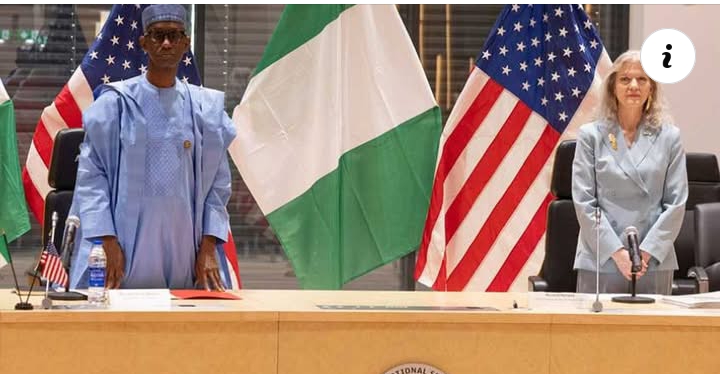
The decision by the Trump administration to establish a US–Nigeria Working Group on Security and Religious Freedom in Abuja deserves clear commendation. It is a timely, principled, and strategic intervention in a country where mass killings, religious persecution, and terrorism have become dangerously normalized. At a moment when the Nigerian state appears either overwhelmed or unwilling to confront the scale of violence consuming its citizens, this move signals that the international community is no longer prepared to look away.
What makes this initiative significant is not merely its diplomatic symbolism, but its focus. By placing security and religious freedom at the center of bilateral engagement, the United States has acknowledged what successive Nigerian governments—especially under the APC—have tried to dilute with euphemisms: that Nigeria is facing systemic violence with genocidal patterns, particularly against vulnerable communities, and that this violence is often enabled by state failure, selective enforcement, and political indifference. From Benue to Plateau, Southern Kaduna to parts of the North-East, the bloodletting follows a familiar script—attacks, denials, token condemnations, and no justice.
In contrast, the Tinubu-led APC government has continued a troubling tradition of strategic silence and moral evasiveness. Terrorist attacks are reduced to “communal clashes,” victims are buried without accountability, and perpetrators melt back into forests with little consequence. Arrests are rare, prosecutions rarer, and convictions almost nonexistent. Even more disturbing is the pattern where warnings are ignored, communities disarmed, and security agencies appear reactive at best and complicit at worst. A government that cannot—or will not—protect its people forfeits the moral authority to ask for patience.
The US working group, therefore, becomes more than a diplomatic platform; it is an implicit indictment of Nigeria’s governance failures. It underscores what local voices, civil society groups, and faith leaders have said for years: that terrorism in Nigeria thrives not just on weapons, but on impunity. By elevating religious freedom alongside security, the Trump administration has also challenged the Nigerian state’s habit of downplaying targeted persecution in favor of politically convenient narratives.
Commendation must also be given for locating this engagement in Abuja, not Washington. It brings scrutiny closer to the scene of the crisis and removes the comfort of distance. It tells Nigerian authorities that excuses will now be interrogated where the bodies fall, not after carefully worded press releases. It also offers hope to victims who have long felt abandoned by both their government and the world.
Ultimately, no foreign initiative can replace responsible leadership at home. The US–Nigeria Working Group can support, pressure, and spotlight—but it cannot substitute for political will. That burden rests squarely on the Tinubu administration and the APC, whose record so far reflects continuity with failure rather than a break from it. History will remember who acted, who enabled, and who chose silence while citizens died.
For now, the United States has taken a necessary step. The question is whether Nigeria’s government is prepared to do the same—or whether it will continue to manage terrorism as a public relations problem rather than a national emergency.


