

Fresh scrutiny of the data published by the Independent National Electoral Commission (INEC) on the 2023 presidential election has raised questions over the verifiability of millions of votes contained in polling-unit result sheets uploaded to the commission’s Result Viewing Portal (IREV).
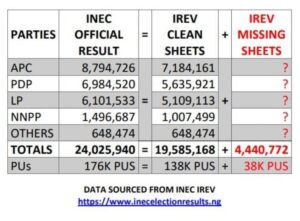
According to the analysis, INEC announced approximately 24 million valid votes from about 176,000 polling units, with the All Progressives Congress (APC) recording about 8.7 million votes, the Peoples Democratic Party (PDP) 6.9 million, the Labour Party (LP) 6.1 million, the New Nigeria Peoples Party (NNPP) 1.4 million and other parties about 600,000 votes.
However, the analysis claims that a review of the documents available on IREV shows a significant discrepancy between the total votes announced and the votes that can be independently reconciled from what it describes as “clean” result sheets.
138,000 Sheets Described as Verifiable
The analysis categorises approximately 138,000 polling-unit result sheets as “clean”—meaning the documents were reportedly clear, readable and sufficiently available for the results to be examined.
When the votes from those sheets were tabulated, the analysis puts the figures at approximately 19.6 million votes, comprising about 7.1 million votes for the APC, 5.6 million for the PDP, 5.1 million for the LP, 1 million for the NNPP and about 600,000 for other parties.
That leaves a substantial difference between the approximately 24 million votes announced by INEC and the 19.6 million votes allegedly traceable to the clean result sheets.
The analysis therefore estimates that roughly 4.4 million votes are embedded in the remaining polling-unit results whose result sheets were allegedly blurred, blank, inaccessible, unavailable or otherwise difficult to independently verify.
The 38,000 Polling Units
The central issue raised by the analysis is the approximately 38,000 polling units whose result sheets are classified as “unclean.”
According to the figures presented, those polling units represent about 21.6 per cent of the roughly 176,000 polling units involved in the election.
The analysis further argues that the approximately 4.4 million votes associated with those polling units amount to about 18 per cent of the total votes announced, making the issue significant enough, in its view, to warrant comprehensive verification.
The concern is not necessarily that the votes contained in the affected polling units were fraudulent. Rather, the argument is that where the underlying result sheets cannot be clearly accessed and independently read, it becomes difficult for observers, political parties and members of the public to independently reconstruct the figures that formed the final presidential tally.
Can the Missing Data Change the Outcome?
The analysis contends that the 138,000 allegedly verifiable polling-unit sheets provide enough information to establish the relative standings of the major presidential candidates within that dataset.
However, it argues that the remaining 38,000 polling units cannot simply be disregarded because their combined votes are sufficiently large to potentially affect the final margins between candidates.
This distinction is important: a discrepancy or inaccessible result sheet does not, by itself, establish that votes were manipulated or improperly allocated. It establishes a verification gap that would need to be resolved by examining the original polling-unit result sheets and reconciling them with the figures aggregated by INEC.
Call for Complete Publication and Reconciliation
The controversy therefore centres on a straightforward demand: that all outstanding or problematic polling-unit result sheets be made available in clear, readable form and that their figures be fully reconciled with the national results announced by INEC.
Such a process would allow independent observers to determine whether the approximately 4.4 million votes attributed to the affected polling units correspond exactly with the figures included in the final declared results and, importantly, which candidates received those votes.
The 2023 presidential election remains one of Nigeria’s most intensely contested elections, with Bola Ahmed Tinubu of the APC declared winner ahead of Atiku Abubakar of the PDP and Peter Obi of the LP. The election generated extensive legal challenges and public debate over the conduct of the polls and the electronic transmission and viewing of polling-unit results.
The latest analysis adds another dimension to that debate by focusing specifically on the completeness and readability of result sheets available through IREV.
Ultimately, the argument is not that the existence of 38,000 problematic sheets automatically invalidates the 2023 election result. Rather, the more than four million votes allegedly associated with those sheets should be independently reconciled if the public is to have complete confidence that every component of the declared national tally can be traced back to an accessible polling-unit result.
Until the affected result sheets are made available, properly read and reconciled with the announced figures, questions about the independent verifiability of that portion of the 2023 presidential election result are likely to persist.


