

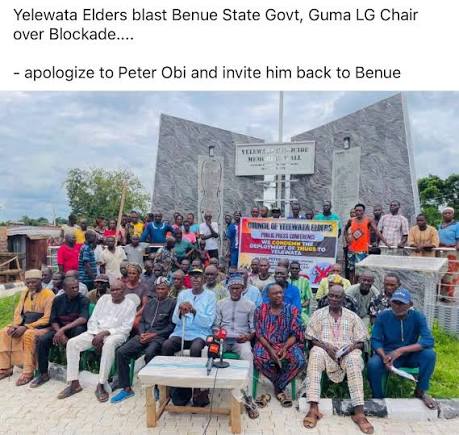
Community leaders condemn reported obstruction of Peter Obi’s convoy, apologise to NDC presidential candidate and invite him back to Yelewata
The Council of Yelewata Elders has accused the Benue State Government, led by Governor Hyacinth Alia, of allegedly diverting donations raised to support families affected by the June 2025 massacre in the community.
The allegation was made during a press conference by representatives of the community, following the controversy surrounding the reported obstruction of the convoy of the 2027 presidential candidate of the Nigeria Democratic Congress (NDC), Peter Obi, during his recent visit to Benue State.
The elders condemned the reported action of youths who allegedly blocked Obi’s convoy while he was attempting to visit communities affected by the violence.
They subsequently apologised to Obi over the incident and dissociated the Yelewata community from the reported obstruction.
The community leaders also invited the NDC presidential candidate to return to Yelewata, assuring him that residents and community elders were prepared to receive him.
Allegation over relief donations
At the centre of the elders’ statement was an allegation concerning the management of donations reportedly received after the June 2025 attack on Yelewata in Guma Local Government Area.
The elders alleged that funds and other donations contributed by individuals, organisations and foreign donors to assist families who lost relatives, homes and livelihoods in the massacre were diverted by the state government.
The allegation, however, remains a claim by the community elders and has not been independently established.
The June 2025 attack left scores of people dead and displaced thousands of residents, according to reports at the time, triggering widespread condemnation and appeals for assistance to victims.
Following the massacre, donations were announced by governments, corporate organisations, private individuals and other groups to provide relief and support reconstruction efforts.
The Benue State Government previously disclosed that approximately ₦1.275 billion had been received from some major donors.
The disclosed contributions included ₦1 billion from the Renewed Hope Initiative of Oluremi Tinubu, ₦150 million from the Nasarawa State Government, ₦100 million from United Bank for Africa and ₦25 million from the Director-General of the Department of State Services.
Community groups, however, have argued that the actual value of assistance could be substantially higher when donations from other individuals, organisations and foreign sources are included.
Government’s explanation
The state government has maintained that the donations were being managed through an established framework rather than being distributed exclusively to Yelewata residents.
Governor Alia’s administration said it established a multi-agency technical committee headed by the Secretary to the State Government, Deborah Aber, to oversee the utilisation of funds and relief resources.
According to the government’s account, the resources have been deployed to several areas, including cash assistance, food, shelter, water and sanitation, healthcare, security, agriculture, education, livelihood support and the resettlement of displaced persons.
The government has also reported the construction of two-bedroom houses, solar-powered boreholes and other infrastructure as part of its intervention and resettlement programme.
The administration has further explained that the donations were intended to assist victims of attacks across Benue State and were therefore not exclusively earmarked for Yelewata.
That position has, however, continued to generate questions among some affected residents and advocacy groups, particularly concerning how much was received in total, how much has been spent, who the beneficiaries are and what remains available for reconstruction and livelihood support.
Obi’s visit sparks fresh controversy
The elders’ intervention also came against the backdrop of the controversy surrounding Obi’s attempted visit to Yelewata and other communities affected by violence in Benue.
Obi and his supporters had alleged that his convoy was deliberately obstructed during the visit, prompting renewed criticism of the security and political environment surrounding efforts to engage directly with victims of the attacks.
The Benue State Government denied involvement in the alleged obstruction and described claims linking the administration to the incident as false.
Government officials have maintained that visits by high-profile political figures to communities affected by insecurity require adequate prior notification and security coordination to prevent additional risks.
The Yelewata elders, however, took a different position, condemning the obstruction and expressing regret over what happened to Obi.
Their invitation for Obi to return to the community represents an attempt by the elders to distance Yelewata residents from the reported incident and reaffirm the community’s willingness to engage with political leaders and other Nigerians seeking to sympathise with victims.
Calls for transparency
The latest allegations have consequently revived calls for greater transparency in the management of donations meant for victims of the Yelewata massacre.
Questions surrounding the intervention include the total amount and value of donations received, the identity and number of beneficiaries, the criteria used in selecting beneficiaries, expenditure records, reconstruction projects and the amount still available for future assistance.
For the allegations to be conclusively resolved, affected residents and the public would require verifiable records showing donations received, expenditure, beneficiaries and projects executed.
An independent audit or publicly accessible financial report could also help establish whether the funds were properly utilised and address lingering suspicions among victims and community members.
For now, the allegation by the Yelewata elders remains a serious claim requiring a response from the Benue State Government and, potentially, an independent investigation.
The controversy comes as Benue continues to grapple with recurring attacks, displacement and the difficult task of rebuilding communities devastated by violence.


