

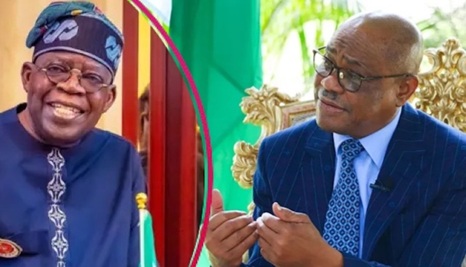
Minister of the Federal Capital Territory, Nyesom Wike, has declared that President Bola Tinubu faces little threat from the opposition ahead of the 2027 presidential election, describing Nigeria’s opposition as “crippled and depleted.”
Wike made the remarks on Tuesday in Abuja while responding to questions about the outcome of the recent Osun State governorship election. He argued that the opposition’s internal divisions, defections and lack of a coordinated political structure would make it difficult for the parties to mount a credible challenge against the ruling All Progressives Congress.
According to the FCT Minister, the 2027 presidential election will be considerably easier for Tinubu than the 2023 contest. He contrasted the two elections, arguing that the opposition in 2023 presented a more formidable challenge, whereas the current opposition is struggling to maintain cohesion.
“2023 was a tough election for him,” Wike said, adding that the political situation would be different in 2027 because the opposition has become weakened.
He argued that a serious opposition seeking to remove an incumbent government must spend years building structures, developing grassroots support and coordinating its political strategy. According to him, political groups that continually move from one party to another in search of an electoral platform cannot easily defeat a well-established ruling party.
Wike was particularly critical of opposition politicians involved in recent political realignments, suggesting that their inability to maintain unity could undermine their presidential ambitions.
“This election, where the opposition has been crippled… depleted,” he said, insisting that the current political configuration gives Tinubu a significant advantage.
He went further to issue a blunt prediction concerning the 2027 presidential race.
“If it is this 2027 election against Bola Ahmed Tinubu, forget it. It’s over,” Wike declared.
The minister also dismissed suggestions that Governor Ademola Adeleke’s victory in the August 15 Osun governorship election represented a setback for Tinubu or the Federal Government.
Adeleke, who contested on the Accord Party platform, defeated the APC candidate, Bola Oyebamiji, in the closely fought election. Wike argued that the Osun result should instead be viewed as evidence that the Tinubu administration allowed the electoral process to proceed without undue federal interference.
He questioned opposition claims that the Federal Government deployed “federal might” to influence the result in favour of the APC, pointing to the fact that Adeleke ultimately won the election.
Wike maintained that governorship elections are often influenced by local political dynamics and should not automatically be used to predict the outcome of a presidential election. He stressed that the national contest would be fundamentally different because of its broader political structure and geographical spread.
His comments have nevertheless intensified the political debate over the strength of the opposition ahead of 2027. Opposition figures and supporters have continued to argue that a united coalition involving major political forces could pose a serious challenge to the APC.
The emergence of new political alignments and the movement of prominent politicians between parties have already reshaped the political landscape ahead of the election.
Wike’s confidence, therefore, contrasts sharply with the optimism among opposition forces seeking to build a broad coalition capable of defeating Tinubu.
As political parties prepare for the 2027 election, the central question will be whether the opposition can overcome its current divisions and translate its various political structures into a single, coordinated electoral force.
For Wike, however, the answer is already clear: unless the opposition undergoes a major transformation, Tinubu’s re-election campaign will face little serious resistance.
The minister’s prediction is likely to fuel further debate in the months ahead, particularly as political parties intensify negotiations, alliances and grassroots mobilisation ahead of the presidential contest.