

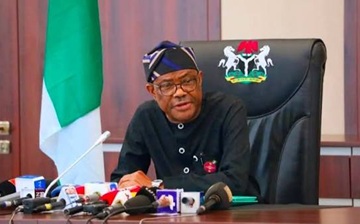
Minister of the Federal Capital Territory, Nyesom Wike, has claimed that he could have helped the All Progressives Congress win the August 15 Osun State governorship election if President Bola Tinubu had wanted the party to secure victory “at all costs.”
Wike made the remark on Tuesday while speaking with journalists in Abuja after inspecting flood-prone areas in Maitama. He was reacting to the victory of Governor Ademola Adeleke of the Accord Party over the APC candidate, Bola Oyebamiji.
Adeleke was declared winner of the closely contested election after securing 511,067 votes against Oyebamiji’s 444,815 votes. The result has generated political debate over the strength of the ruling party and opposition ahead of the 2027 general elections.
Wike, however, rejected suggestions that Adeleke’s victory represented a defeat for Tinubu or the Federal Government. Instead, he argued that the President deliberately allowed the election to proceed without deploying federal influence to favour the APC.
According to the minister, if Tinubu had been determined to win Osun at all costs, he would have personally been involved in the campaign effort and the outcome would have been different.
“I’m part of the Federal Government. I’m sure if the President wanted to win Osun at all costs, I would have been there, and we would have won it,” Wike said.
He argued that the election demonstrated the administration’s willingness to allow the democratic process to run without undue interference.
Wike also dismissed claims that the Osun result reflected growing opposition strength ahead of 2027. He described the opposition as weakened and fragmented, insisting that political parties must build structures and mobilise voters long before election day if they hope to win elections.
The minister went further to predict that Tinubu would have a much easier path to re-election in 2027 than he faced during the 2023 presidential election. He described the opposition as “crippled” and “depleted,” arguing that the political landscape had changed significantly since 2023.
Wike also pointed to what he described as the absence of “federal might” during the Osun election. Comparing the situation with his experience during the 2019 Rivers State election, he questioned whether voters in Osun witnessed the kind of federal intervention he claimed occurred in Rivers at the time.
“Did anything like that happen in Osun State?” he asked.
His comments have nevertheless attracted criticism from opposition figures. Dele Momodu, a chieftain of the African Democratic Congress, faulted Wike’s assertion that he could have secured an APC victory, arguing that the political circumstances in Osun could not simply be compared with Wike’s previous electoral experience in Rivers State.
The controversy comes as political parties increasingly position themselves for the 2027 presidential contest. The Osun election has become an important political reference point, with supporters of the ruling party and opposition interpreting Adeleke’s victory differently.
While Wike sees the outcome as evidence of a government willing to permit a free contest, opposition figures see the result as proof that the ruling party can be defeated when voters are presented with a competitive alternative.
The minister’s comments have therefore added a new dimension to the debate over the implications of the Osun election for 2027.
For now, Wike remains confident that Tinubu’s political machinery is strong enough to deliver victory in the next presidential election, while opposition parties are expected to use the Osun result to reassess their strategies ahead of what promises to be another fiercely contested national poll.