

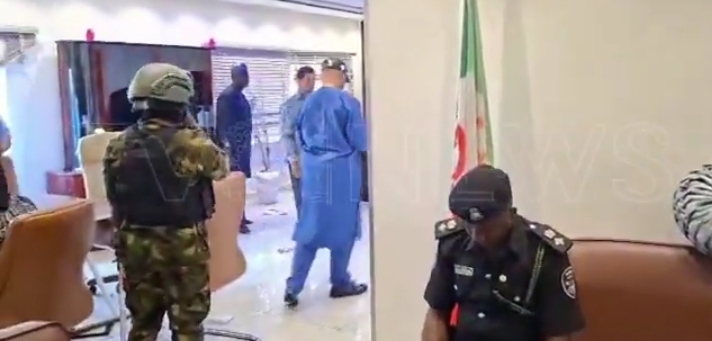
In a deeply unsettling development that raises serious concerns about the rule of law in Nigeria, reports have emerged that security personnel, including soldiers, allegedly accompanied Musiliu Akinsanya—popularly known as MC Oluomo—to take control of the national secretariat of the National Union of Road Transport Workers (NURTW), despite a subsisting court judgment said to have removed him from office.

This incident, if accurately represented, paints a grim picture of institutional breakdown, where the very forces entrusted with upholding the law appear to be complicit in its circumvention. The defiance of judicial authority not only undermines the sanctity of the courts but also sets a dangerous precedent that could erode public confidence in governance and democratic order.
The involvement of armed security personnel in what is essentially a civil dispute within a trade union further complicates the narrative. It raises urgent questions about the neutrality of state institutions and whether they are being deployed selectively to advance particular interests.
For many Nigerians, this is more than just a leadership tussle within the NURTW—it is a reflection of a broader governance challenge where legality is often overshadowed by power. When court rulings can be so brazenly disregarded, what assurance remains for the ordinary citizen seeking justice?
As the nation grapples with mounting socio-economic pressures and insecurity, episodes like this deepen public disillusionment. They provoke a fundamental question: what kind of society are we building, and what legacy are we leaving for future generations?
The credibility of Nigeria’s democratic institutions rests heavily on adherence to the rule of law. Anything short of this risks pushing the country further down a path where might supersedes right—a trajectory that must be urgently corrected.


