

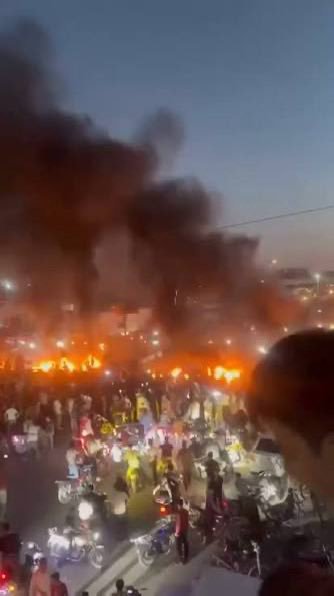
The streets of Syria have once again become a theatre of public resistance, following a sharp increase in fuel prices that has triggered protests across parts of the country. The development offers a striking and uncomfortable comparison with Nigeria, where petrol prices have risen dramatically over the years while millions of citizens continue to endure the consequences with comparatively little sustained mass resistance.
In Syria, a 40 per cent increase in diesel prices was enough to send protesters into the streets. Demonstrators blocked roads, disrupted fuel-tanker routes and demanded that the government reverse the increase. The protests underline a simple principle: when citizens believe an economic policy has crossed a painful threshold, they can collectively demand that government reconsider.
Nigeria tells a remarkably different story.
In February 2015, petrol sold for ₦87 per litre following the reduction of the pump price from ₦97 under the administration of former President Goodluck Jonathan. Today, petrol is reportedly selling for about ₦1,500 per litre in Abuja.
That represents an increase of approximately 1,624 per cent from ₦87.
In other words, while Syrians have taken to the streets over a 40 per cent fuel-price increase, Nigerians in the nation’s capital are confronting a petrol price more than 17 times what it was in 2015.
The contrast is difficult to ignore.
For Nigerians, petrol is not merely another commodity. It is the lifeblood of an economy heavily dependent on road transportation and fuel-powered businesses. When petrol prices rise, the consequences cascade through virtually every aspect of daily life.
Transport fares increase. The cost of moving food from farms to markets rises. Traders increase prices. Artisans pay more to operate their generators. Manufacturers face higher logistics and energy costs. Families spend more simply to get children to school and workers to their places of employment.
The poorest Nigerians are often hit hardest because they spend a greater proportion of their income on transportation and basic necessities. Yet the country has witnessed successive rounds of fuel-price increases without the kind of sustained nationwide mobilisation currently being witnessed in Syria.
The uncomfortable Nigerian question
The comparison raises an uncomfortable question: Have Nigerians become exceptionally resilient, or have they become too accustomed to hardship?
There is a difference between resilience and docility.
Resilience means enduring difficult circumstances while demanding accountability and working collectively for change. Docility occurs when citizens become so accustomed to suffering that increasingly severe economic pressures are accepted as inevitable. Nigeria must be careful not to confuse the two.
For years, Nigerians have been told that painful economic reforms are necessary to rescue the economy. Citizens have been asked to endure higher fuel prices, higher electricity costs, rising food prices and a declining purchasing power in the expectation that the sacrifices will eventually produce prosperity.
But for many households, the promised relief remains elusive.
The question is therefore not whether Nigeria needs economic reforms. It is whether the burden of reform is being distributed fairly and whether government is sufficiently accountable for the consequences of its policies.
Syria has demonstrated the power of collective resistance The Syrian protests are a reminder that citizens do not necessarily have to wait until an economy completely collapses before demanding accountability.
A 40 per cent fuel increase was enough to produce visible resistance. Nigeria’s fuel price, by comparison, has moved from ₦87 to approximately ₦1,500 per litre in Abuja—a rise of roughly 1,624 per cent—yet the response has largely been fragmented and episodic. That contrast should concern every Nigerian.
A democracy cannot function effectively when citizens believe that government decisions are beyond public scrutiny. Equally, citizens must exercise their democratic rights peacefully and responsibly through lawful protest, public debate, elections, civic organisation and demands for transparency.
The lesson from Syria is therefore not that Nigerians should copy Syrian protesters. It is that citizens have power when they act collectively and peacefully around issues that directly affect their lives.
From ₦87 to ₦1,500: What happened to the Nigerian threshold?
The journey from ₦87 to ₦1,500 per litre represents more than a change in the price displayed at filling stations. It represents the changing purchasing power of Nigerian families and the transformation of the cost of survival.
A worker who once spent a modest amount travelling to work now faces dramatically higher transportation costs. A farmer who depends on petrol-powered equipment and transportation faces higher production expenses. A small business owner who relies on a generator faces another layer of operating costs.
And ultimately, these costs are transferred to the consumer.
This is why the fuel-price debate cannot be reduced to the pump price alone. The real price of petrol is measured by the cost of living it creates.
Syria’s 40 per cent increase has produced protests because citizens have drawn a line. Nigeria’s experience poses a different question: Where is Nigeria’s line?
How high must petrol prices rise?
How expensive must transportation become?
How much must food cost?
How far must wages fall in real terms before citizens collectively demand answers?
These are not questions about political parties. They are questions about citizenship, accountability and the social contract between government and the governed.
A tale of two countries;
Syria and Nigeria are obviously different countries with different histories, political systems and economic circumstances. Their situations cannot be mechanically equated.
But the contrast remains instructive.
In Syria, a 40 per cent fuel-price increase triggered resistance. In Nigeria, petrol has risen from ₦87 to about ₦1,500 per litre in Abuja, while millions continue to struggle to adjust.
The issue is not simply who protests more.
The deeper issue is what happens when citizens lose the expectation that their collective voice can influence government policy.
A healthy democracy requires neither blind obedience nor destructive confrontation. It requires an informed citizenry willing to ask difficult questions, organise peacefully and hold those in power accountable.
Perhaps, therefore, the most important lesson from Syria is not about fuel.
It is about the relationship between citizens and power.
When citizens resist peacefully and collectively, government hears a warning.
When citizens endure everything without sustained accountability, government may interpret silence as acceptance.
That is the uncomfortable comparison between Syria and Nigeria: one country is protesting a 40 per cent fuel hike; the other is learning to live with ₦1,500 per litre.
When resistance meets docility, history eventually records which society demanded better—and which simply learned to endure.


