

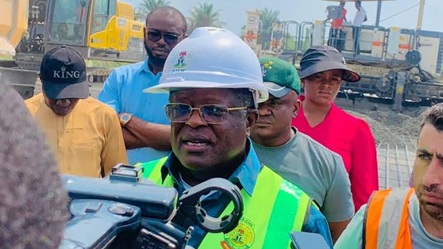
Minister of Works David Umahi has ordered the concessionaire handling the Benin–Agbor–Asaba highway to quit the project over what he described as unacceptable workmanship, poor technical capacity and a failure to follow engineering instructions.
The minister’s intervention followed mounting public outrage over the worsening condition of the strategic highway, where motorists have recently faced severe traffic, flooding, vehicle damage and journeys lasting several hours longer than normal.
Umahi specifically accused the Benin-Asaba Expressway Concession Company (BAECC) of worsening the situation by removing existing asphalt before putting adequate drainage and replacement pavement in place.
The minister said the Ministry of Works had warned the concessionaire against removing the asphalt, arguing that the road was in considerably better condition when it was handed over. He also ordered that contractors who unnecessarily strip asphalt from existing roads should be arrested.
Government Questions Concessionaire’s Competence
Umahi was particularly scathing in his assessment of BAECC’s performance, questioning whether the company had the technical personnel and competence required to execute a project of such importance.
The Benin-Asaba road was concessioned in 2025 for reconstruction and expansion from four lanes to 10 lanes. But the project has encountered serious implementation problems, with motorists and businesses bearing much of the consequences.
The project’s consultant also reportedly told the minister that BAECC ignored instructions to construct drainage infrastructure first, a decision he said contributed to the deterioration of the road.
BAECC’s CEO, Samuel Daramola, however, offered a different explanation. He blamed heavy rainfall and enormous traffic volumes, saying the company faced difficulty constructing drainage while keeping the highway open to motorists. He maintained that the company remained committed to completing the project.
Tinubu Orders Emergency Intervention
President Bola Tinubu has directed the Works Ministry to take whatever steps are necessary to address the crisis.
Umahi said the President had also ordered the redesign of roads stretching from Kogi through Edo towards Warri, with concrete pavement being considered for major reconstruction works.
The minister stressed that the solution should go beyond temporary patching:
“We need total reconstruction of this road and not this palliative.”
The Federal Government is also considering a broader review of road concession agreements, following calls from lawmakers for greater scrutiny of private companies handling critical federal highways.
Motorists and Businesses Are Paying the Price
The consequences have extended well beyond traffic congestion.
Drivers have reported journeys that previously took around 90 minutes stretching to several hours, while frequent exposure to failed sections has increased vehicle maintenance costs.
Businesses along the corridor have also suffered as flooding and gridlock reduce customer traffic and make transportation more expensive. Traders have reported increasing the prices of their goods because of higher transport costs.
The Benin-Asaba corridor is particularly important because it connects major economic centres in the South-South and South-East and carries substantial passenger and freight traffic.
The Bigger Question
The crisis raises an important question about Nigeria’s public-private partnership model for infrastructure.
Concessioning major highways can reduce the immediate financial burden on government and bring private capital into infrastructure development. But when a concessionaire fails to meet technical requirements, the public ultimately bears the consequences.
The House Committee on Works has therefore called for a review of concession agreements to ensure that companies entrusted with strategic highways have the technical capacity to deliver them.
For stranded motorists, however, the argument over the concession agreement is secondary.
They need the road restored, businesses need movement to resume, and Nigerians need accountability for how a major national highway reached this condition in the first place.
The real test of the government’s intervention will now be whether the latest orders produce a safe, durable and properly engineered road—not another cycle of emergency repairs and blame-shifting.