
President Bola Ahmed Tinubu has asked a United States federal court to prevent the release of records held by the U.S. Department of Justice, Federal Bureau of Investigation (FBI) and Drug Enforcement Administration (DEA) concerning past investigations linked to him.
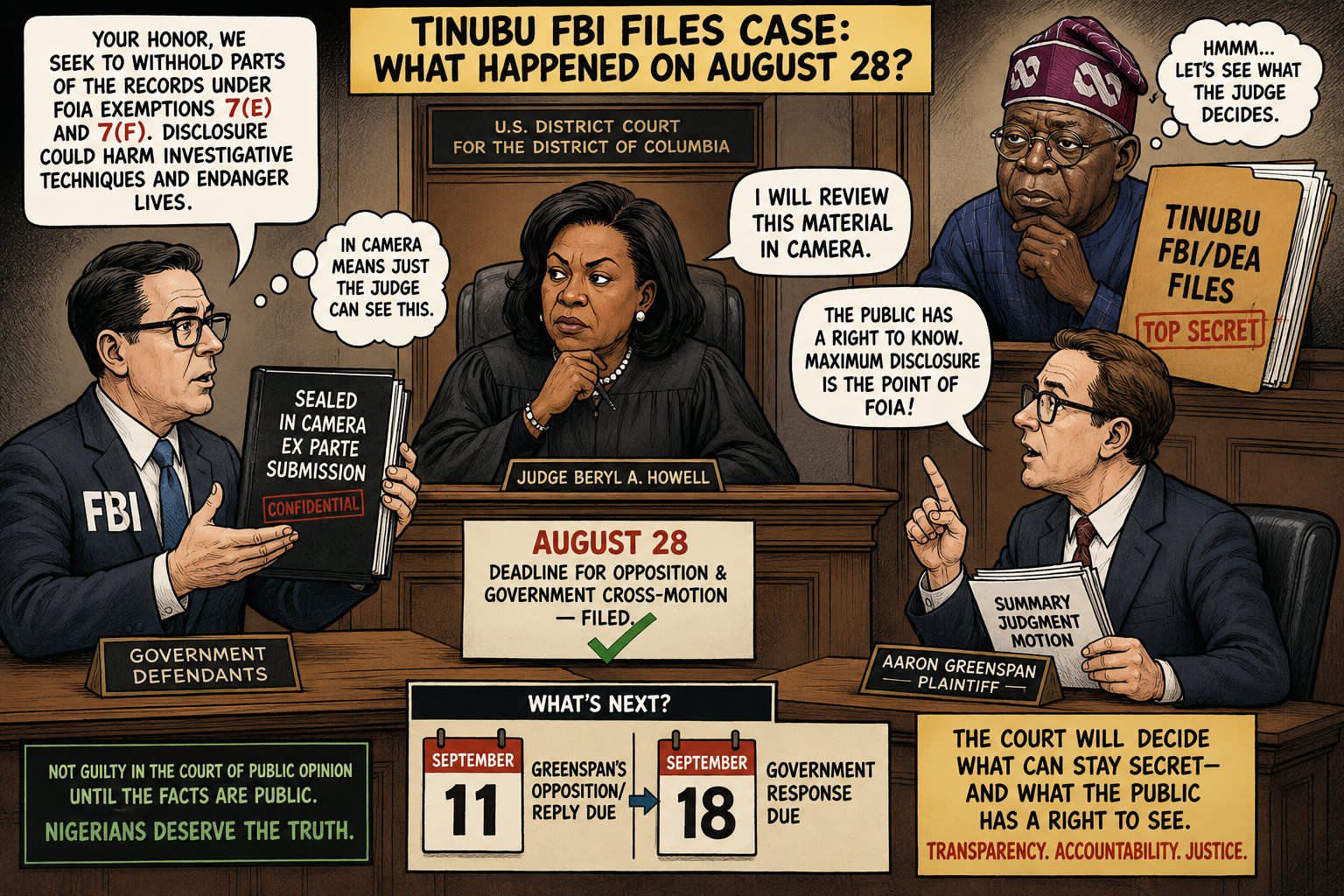
The development was disclosed in a 16-page court filing submitted by Tinubu’s legal team in an ongoing Freedom of Information Act (FOIA) litigation initiated by American transparency activist Aaron Greenspan.
Greenspan is seeking access to records relating to investigations involving Tinubu, including what has been described as the FBI’s file on the Nigerian president and FBI Form 302 interview records covering the period between 1992 and 1993. The request also involves records connected to a 1993 civil forfeiture proceeding in the United States involving approximately $460,000.
Tinubu invokes privacy rights
According to the filing, Tinubu’s lawyers argue that releasing undisclosed information would violate his privacy rights. They maintain that the president has committed no wrongdoing and contend that the fact that some information about him may already be publicly available does not eliminate his privacy interest in previously undisclosed government records.
The legal challenge does not itself establish that Tinubu committed any offence. Rather, it represents an attempt to prevent U.S. government agencies from disclosing records being sought through the FOIA process.
Tinubu has consistently denied wrongdoing in relation to the allegations surrounding his past in the United States.
Transparency activist seeks disclosure
The records are being pursued by Greenspan through a FOIA lawsuit against several U.S. government agencies. The case, identified as Greenspan v. Executive Office for U.S. Attorneys et al., is pending before the United States District Court for the District of Columbia under case number 1:23-cv-01816-BAH.
The dispute therefore places the Nigerian president’s privacy claims directly against Greenspan’s demand for greater public access to historical government records.
What happens next?
The U.S. court will ultimately determine whether the records, or portions of them, can be released under American freedom-of-information law and whether Tinubu has a legally protected privacy interest sufficient to prevent disclosure.
The case is likely to attract considerable attention in Nigeria because any release of previously undisclosed FBI, DEA or Justice Department records could provide additional information about investigations surrounding Tinubu’s activities in the United States in the 1990s.
For now, however, the existence of the court challenge should not be interpreted as proof of criminal wrongdoing, nor does the filing mean that the records sought by Greenspan have been released or that the allegations have been judicially established.
The immediate issue before the U.S. court is whether the requested records should be disclosed—not whether President Tinubu is guilty of drug trafficking.
Tinubu Moves to Block Release of US Records Linked to Past Drug Trafficking Allegations

- Advertisement -

