

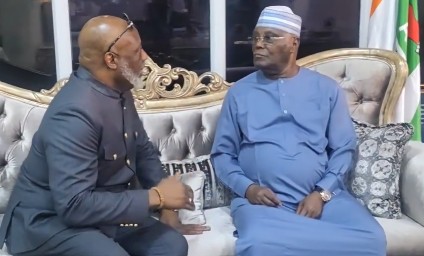
Former Kogi West Senator Dino Melaye has stirred political debate after publicly declaring former Vice President Atiku Abubakar as Nigeria’s next president in a series of social media posts that have generated widespread reactions across the political spectrum.
On July 30, Melaye shared photographs of himself alongside the former vice president and accompanied the images with messages expressing confidence that Atiku would emerge victorious in the 2027 presidential election.
The outspoken politician, who has long been one of Atiku’s most vocal supporters, also used popular Nigerian political slang to suggest that President Bola Ahmed Tinubu and his supporters were becoming increasingly concerned about the opposition’s prospects ahead of the next general election.
The posts quickly attracted attention on social media, drawing thousands of comments from supporters, critics and political observers.
Supporters of Atiku interpreted Melaye’s remarks as a strong endorsement of the former vice president’s political ambitions and a signal that opposition forces are already positioning themselves for the 2027 electoral contest.
Many argued that Atiku remains one of Nigeria’s most experienced political figures and could still play a significant role in shaping the country’s political future.
Critics, however, dismissed Melaye’s prediction as premature and unrealistic, pointing to Atiku’s unsuccessful presidential bids in both the 2019 and 2023 elections.
Some commentators argued that political declarations made years before an election rarely determine the eventual outcome, emphasizing that voter sentiment, party strength, campaign strategy and prevailing national issues will ultimately shape the contest.
Others used the opportunity to defend President Tinubu, highlighting his victory in the 2023 presidential election and insisting that the ruling party remains firmly positioned ahead of the next electoral cycle.
Political analysts note that although the 2027 election is still some distance away, political maneuvering, alliance-building and public endorsements have already begun to intensify across the country.
They observe that statements such as Melaye’s are often intended to energize supporters, project confidence and keep political figures in the public conversation as parties begin preparations for future contests.
The development also reflects the growing competition between the ruling party and opposition groups, with leading politicians increasingly seeking to shape public perception ahead of what is expected to be another highly contested election.
Atiku Abubakar himself has not formally responded to Melaye’s latest endorsement, though the former vice president has remained active in national political discussions and opposition consultations.
Observers say the reaction to Melaye’s comments demonstrates how discussions about the 2027 presidential race are already gaining momentum despite the election still being years away.
As political activities continue to evolve, analysts expect more endorsements, coalition talks and strategic positioning from both ruling and opposition figures seeking to influence the direction of Nigeria’s next presidential contest.


