

Abuja 1st September, 2026.
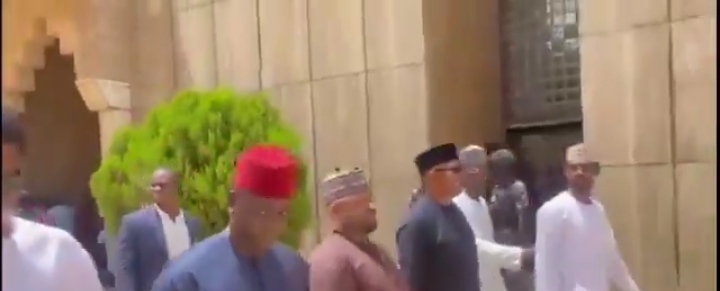
Former Anambra State governor and Nigeria Democratic Congress (NDC) presidential candidate, Peter Obi, was reportedly spotted entering the Abuja National Mosque, a development that has generated reactions within political circles and renewed conversations about national unity and religious tolerance.
The reported sighting occurred amid heightened political activities ahead of the 2027 general elections, with political stakeholders increasingly paying attention to the public movements and engagements of prominent opposition figures.
While the purpose of Obi’s visit has not yet been publicly disclosed, Nigerians are awaiting a formal statement from him to clarify the circumstances surrounding his appearance at the National Mosque.
The visit has nevertheless attracted attention because of Obi’s repeated advocacy for national unity, inclusion and the need for Nigerians to overcome ethnic, religious and regional divisions. His supporters have described the reported appearance as consistent with his longstanding message that the country’s diversity should be viewed as a strength rather than a source of division.
The Abuja National Mosque is one of Nigeria’s most prominent Islamic landmarks and a major symbol of the country’s Muslim community. The reported presence of a prominent political figure at the facility has therefore generated considerable public interest, particularly at a time when religion and ethnicity remain sensitive issues in Nigeria’s political discourse.
The development has also reportedly unsettled some supporters of the ruling All Progressives Congress (APC), with political observers watching closely for any political significance that may emerge from the visit. However, there has been no official statement from the APC confirming that the party was unsettled by Obi’s reported appearance, while no evidence has so far established that the visit was politically motivated.
For many observers, however, the significance of the development may extend beyond partisan politics. Nigeria has continued to grapple with ethnic and religious tensions, making gestures that promote interaction and mutual respect between different communities particularly important.
While Nigerians await a public address from Mr Peter Obi, the reported visit has, no doubt, inspired the message of national unity that he has consistently preached. His supporters believe that the ability of political leaders to interact across religious and regional boundaries could contribute to reducing suspicion and strengthening national cohesion.
The development also comes at a period when political parties and aspirants are beginning to intensify preparations for the 2027 elections. Consequently, even seemingly routine engagements involving major political figures are attracting heightened public and political scrutiny.
Whether Obi’s visit was personal, religious or carried a broader message will become clearer if he chooses to publicly address the development. Until then, political interpretations remain speculative.
For a country as diverse as Nigeria, however, the reported visit has opened another conversation about the kind of political culture Nigerians expect ahead of 2027—one that places national interest, tolerance, peaceful coexistence and unity above religious and ethnic differences.
As the country awaits Mr Peter Obi’s explanation, one message appears to have resonated strongly: Nigeria’s unity remains a responsibility that transcends political parties, religion and ethnicity.


