

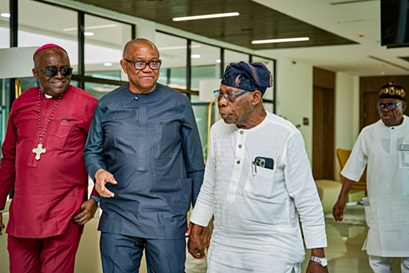
The presidential candidate of the Nigeria Democratic Congress (NDC), Peter Obi, on Wednesday met with former President Olusegun Obasanjo, a development that has fueled fresh speculation about opposition collaboration ahead of the 2027 general elections.
The meeting, held behind closed doors, attracted considerable political attention as photographs circulating online showed the two leaders in traditional attire engaged in discussions. Also present at the gathering were a Catholic bishop and several aides, although no official statement was issued on the outcome of the talks.
Neither Obi nor Obasanjo disclosed the agenda of the meeting, leaving political observers to speculate on the issues discussed. However, the timing of the visit has intensified public interest because it comes amid ongoing realignments within Nigeria’s opposition ahead of the next presidential election.
The meeting follows the emergence of the Peter Obi–Rabiu Kwankwaso presidential ticket under the Nigeria Democratic Congress, a political development that has generated debate over the prospects of a united opposition challenging the ruling All Progressives Congress (APC) in 2027.
Political analysts believe Obasanjo, who has remained an influential figure in Nigerian politics despite leaving office in 2007, continues to command significant moral and political influence across party lines. His engagements with leading political actors are therefore often viewed as strategically important.
Supporters of the opposition argue that consultations among key political leaders are necessary to build consensus, strengthen democratic competition and present a credible alternative to the incumbent administration.
Others, however, caution against reading too much into the meeting, noting that political consultations are common in Nigeria and do not necessarily indicate the formation of formal alliances or electoral agreements.
The closed-door discussions have also revived conversations about the role of elder statesmen in shaping Nigeria’s political landscape. Analysts say former presidents often serve as advisers, mediators and conveners during periods of political transition and realignment.
Neither the NDC nor Obasanjo’s office has confirmed whether the discussions centered on coalition-building, governance, national issues or preparations for the 2027 elections.
Observers note that as political parties intensify consultations ahead of the election cycle, meetings between influential leaders are likely to become more frequent, reflecting efforts to forge strategic partnerships and address national challenges.
Political commentators also emphasize that while alliances can strengthen electoral prospects, their success ultimately depends on shared policy objectives, effective organization and the ability to inspire public confidence.
As Nigerians await further details, the meeting between Obi and Obasanjo has added another dimension to the evolving political landscape, with many closely watching future engagements that could shape the configuration of opposition politics ahead of the 2027 presidential election.