

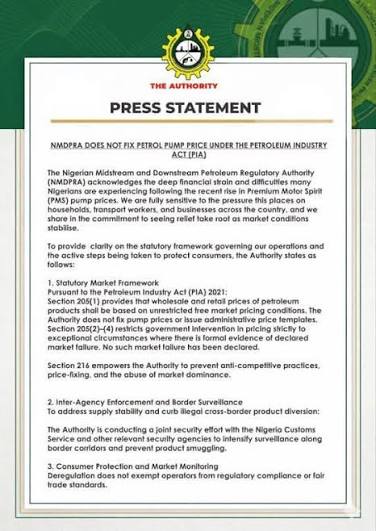
The Nigerian Midstream and Downstream Petroleum Regulatory Authority (NMDPRA) has explained why it cannot fix petrol prices in Nigeria, saying the country’s downstream petroleum sector operates under a deregulated, free-market framework.
The clarification comes amid renewed concerns over rising Premium Motor Spirit (PMS) prices, with petrol selling for as much as N1,450 per litre in some parts of the country. The regulator said its role is to oversee the market rather than determine the price motorists pay at filling stations.
According to the NMDPRA, Section 205(1) of the Petroleum Industry Act (PIA) 2021 provides that wholesale and retail petroleum prices should be determined under unrestricted free-market conditions. The authority therefore said it does not set pump prices or issue administrative pricing templates.
The agency added that government intervention in petroleum pricing is restricted to exceptional circumstances where there is formal evidence of a declared market failure. It said no such market failure has currently been declared.
The NMDPRA also pointed to its regulatory responsibilities under Section 216 of the PIA, including preventing anti-competitive practices, price-fixing and abuse of market dominance. It said it is working with the Federal Competition and Consumer Protection Commission (FCCPC) to monitor possible price-gouging, collusion, under-dispensing and other unfair practices.
The authority further said it is collaborating with the Nigeria Customs Service and security agencies to strengthen surveillance along border corridors and curb the illegal diversion and smuggling of petroleum products.
The development is important because petrol prices directly affect transportation, food distribution, business operating costs and household expenses. Recent increases have therefore intensified calls for measures that could provide relief to consumers.
Earlier, NMDPRA Head of Public Affairs George Ene-Ita identified crude sourcing, refining capacity, transportation, landing costs and taxes among factors influencing petrol prices under deregulation. He said stronger domestic refining could eventually improve pricing conditions for consumers.
The NMDPRA said it remains committed to consumer protection and fair competition while allowing market forces to determine petrol prices under the existing legal framework.


