

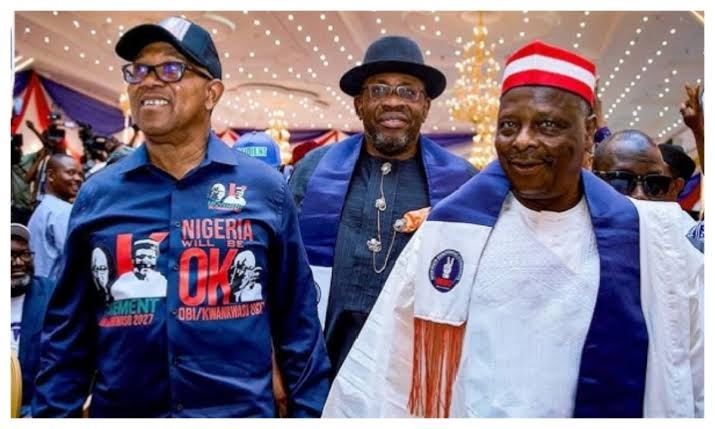
Fresh disagreements have emerged between the Nigeria Democratic Congress and support groups backing its 2027 presidential ticket of Peter Obi and Rabiu Kwankwaso over the party’s decision to register support organisations ahead of the general elections.
The latest dispute centres on whether groups such as the Obi-Kwankwaso Movement and Kwankwasiyya should operate independently or be formally registered and coordinated under the NDC structure.
The NDC recently announced that it had commenced registration of support groups through its Directorate of Support Groups at the party’s national headquarters in Abuja. The party said the exercise was free and warned state chapters against collecting fees from organisations seeking registration.
NDC National Publicity Secretary Osa Director said the registration of support groups was exclusively the responsibility of the Directorate of Support Groups at the national headquarters. He added that no state chapter, officer or party official had been authorised to register groups or collect money for the process.
The party also warned that violations of the directive would attract disciplinary action under its constitution.
The announcement, however, was rejected by the Director-General of the Obi-Kwankwaso Movement, John Ughulu, who maintained that the movement was an independent political organisation with its own structures.
Ughulu argued that the movement’s existence and internal affairs did not require approval from the NDC leadership. He said the group would resist any attempt to appropriate, dissolve or absorb its national, state, local government and ward structures.
The disagreement is the latest in a series of disputes between the party and the support movement over the organisation of the 2027 campaign.
Earlier in September, the NDC rejected a 59-member Presidential Campaign Council announced by the OK Movement, saying the support group was not authorised to constitute or announce a campaign structure in the party’s name without approval from the National Working Committee.
Peter Obi subsequently backed the party’s position, saying the NDC was the political platform under which he and his supporters were contesting the election. He said the Obi-Kwankwaso Movement, Obidient groups and Kwankwasiyya should function as support organisations rather than as substitutes for the party.
The Kwankwasiyya Movement, however, has adopted a more conciliatory position in the latest disagreement.
Its spokesman, Habibu Muhammed, acknowledged that the NDC was still developing its structures as a relatively new political party and said some of the disagreements were linked to the process of building a new organisation.
Muhammed called for greater understanding between the party and the support groups, arguing that the Kwankwasiyya and Obidient movements had existed independently before the formation of the current political arrangement.
He said the various groups shared the objective of supporting the Obi-Kwankwaso ticket and urged the NDC to create an environment where different support organisations could contribute without unnecessary restrictions.
According to him, some members of the support groups belong to other political parties or are not formally affiliated with the NDC but nevertheless support the presidential ticket.
He also pointed to the existence of support groups associated with other political parties, arguing that such organisations can mobilise supporters and raise funds without necessarily being incorporated into the formal structures of their parties.
The latest dispute therefore reflects a broader question about the relationship between political parties and independent support organisations during election campaigns.
The NDC maintains that official campaign structures must operate with party approval, while the OK Movement insists that its independent organisational identity and internal structures should be respected.
At the same time, some NDC state chapters have reported different experiences. In several states, party officials have said they are working with the various movements to develop a common campaign structure, while others have complained that existing party structures have been sidelined.
The NDC has also indicated that it is working towards an official campaign structure that would accommodate different interest groups.
With the 2027 elections approaching, the dispute highlights the organisational challenges involved in coordinating a political party with established support movements operating across different regions and constituencies. The parties involved will ultimately have to resolve the question of how independent support groups can participate in the campaign while the NDC retains responsibility for its official electoral structures.


