

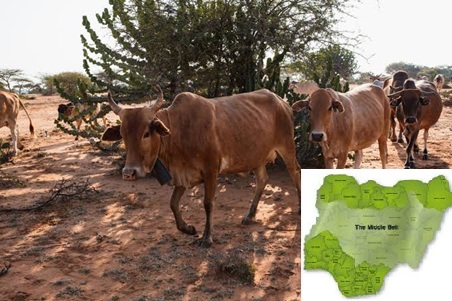
The Middle Belt Forum has rejected the Federal Government’s renewed cattle ranching policy, describing the proposal as a disguised attempt to take control of ancestral lands under the guise of livestock development.
The group expressed strong opposition to the policy, arguing that the Federal Government should not impose ranching arrangements on communities without adequate consultation, consent and protection of land rights.
The MBF said the proposal, rather than addressing the longstanding crisis between farmers and herders, could deepen tensions across the Middle Belt if communities believe their lands are being appropriated for government-backed livestock projects.
The forum’s position comes amid renewed efforts by the Federal Government to promote ranching as part of its strategy for addressing open grazing, livestock production and recurring clashes between farmers and herders.
For years, the farmer-herder crisis has remained one of Nigeria’s most persistent security and agricultural challenges. Disputes over access to farmland, grazing routes, water sources and settlement patterns have contributed to violent confrontations in several states.
The Federal Government has increasingly advocated ranching as a more sustainable alternative to open grazing, arguing that modern livestock production requires dedicated infrastructure, veterinary services, water supply and improved breeding systems.
However, the MBF maintains that any policy involving land must take into account the rights and interests of communities that depend on the land for farming and other economic activities.
The forum accused the government of attempting to present the acquisition or allocation of land as livestock development, warning that such an approach could generate resistance from affected communities.
According to the group, the government should prioritise security, responsible land management and agricultural development rather than policies that could create fresh disputes over ownership and control of land.
The MBF’s rejection is particularly significant because several Middle Belt states have experienced some of the most devastating consequences of farmer-herder conflicts.
Communities in Benue, Plateau, Nasarawa and parts of neighbouring states have repeatedly reported attacks, displacement and destruction of homes and farmlands linked to violent conflicts involving farming communities and armed herders.
The forum argued that government policy should therefore focus first on protecting citizens and preventing armed groups from exploiting grazing disputes to perpetrate violence.
It also called for greater consultation with state governments, traditional institutions, farmers’ associations, pastoralist communities and other stakeholders before any major livestock or land policy is implemented.
The disagreement highlights a fundamental challenge facing Nigeria’s efforts to reform its livestock sector: how to modernise cattle production without creating new disputes over land ownership and access.
Supporters of ranching argue that controlled livestock production could reduce pressure on farmland, limit conflicts over grazing routes and improve cattle productivity. Critics, however, fear that poorly designed ranching programmes could lead to large-scale land acquisition or unfair displacement of farming communities.
The MBF’s latest position suggests that the Federal Government could face significant resistance if it proceeds without addressing these concerns.
The forum is expected to continue engaging stakeholders and mobilising public opinion against what it considers policies that threaten the interests of Middle Belt communities.
For the government, the challenge will be to demonstrate that its livestock development programme is genuinely designed to modernise agriculture and resolve farmer-herder conflicts rather than facilitate the transfer of community lands.
As the debate continues, the controversy over ranching underscores the need for a transparent and inclusive approach to land and livestock policy—one that balances the economic interests of the livestock sector with the constitutional rights and livelihoods of farming communities.
Without broad consultation and clear safeguards for landowners and host communities, the MBF’s opposition suggests that the renewed ranching policy could become another source of political and social tension rather than a solution to Nigeria’s farmer-herder crisis.