

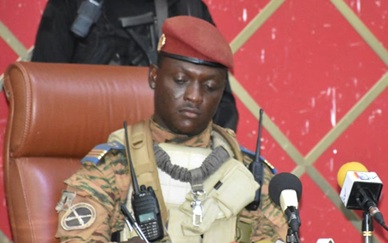
Burkina Faso’s military leader, Captain Ibrahim Traore, has declared that “the battle has begun” against what he described as “radical Islam,” signaling a significant escalation in the country’s relationship with influential Muslim leaders amid growing political and security tensions.
Traore’s remarks come at a time when his military government is facing increasing criticism over its handling of religious affairs following the arrest of several prominent Islamic clerics and the enactment of a controversial law regulating religious activities. The latest developments have heightened concerns about a widening rift between the ruling junta and sections of Burkina Faso’s predominantly Muslim population.
Speaking against the backdrop of the country’s prolonged security crisis, Traore insisted that the government would not tolerate any form of religious extremism capable of undermining national stability. His declaration that “the battle has begun” has been widely interpreted as an indication of the government’s determination to intensify its campaign against groups it believes are promoting radical ideologies.
The statement, however, has sparked mixed reactions among political observers and religious stakeholders, many of whom fear that the government’s broad rhetoric could further strain relations with respected Muslim scholars whose influence extends across communities. Critics argue that while confronting violent extremism is necessary, targeting influential clerics without transparent legal processes could deepen mistrust and create new sources of instability.
Burkina Faso has been battling a deadly insurgency linked to extremist groups for nearly a decade. Armed factions affiliated with al-Qaeda and the Islamic State have carried out repeated attacks across large parts of the country, resulting in thousands of deaths and the displacement of millions of people. The worsening insecurity has also contributed to political instability, including two military coups in 2022 that ultimately brought Traore to power.
Since assuming office, Traore has pledged to restore security and reclaim territories under the control of insurgent groups. His administration has expanded military operations, mobilized civilian volunteers, and strengthened security cooperation with regional partners in an effort to contain the insurgency. Despite these measures, attacks by armed groups have continued in several regions, keeping pressure on the military-led government.
The latest confrontation with Muslim scholars introduces a new dimension to the country’s already complex security and political landscape. Analysts warn that alienating influential religious leaders could undermine community cooperation, which is considered vital in efforts to combat violent extremism. Religious institutions have traditionally played an important role in promoting peace, mediating conflicts, and discouraging the spread of extremist ideologies.
Observers also note that the recently enacted religious law has generated debate over the balance between national security and religious freedom. While government officials maintain that the legislation is intended to prevent the misuse of religion by extremist elements, critics argue that some of its provisions could restrict legitimate religious activities and weaken trust between the state and faith-based organizations.
As Burkina Faso continues to confront one of the most serious security crises in its history, Traore’s decision to openly challenge what he describes as radical Islam is expected to remain a defining feature of his administration. Whether the strategy succeeds in weakening extremist influence or further complicates relations with the country’s Muslim community will likely shape both the nation’s security outlook and its political future.


