

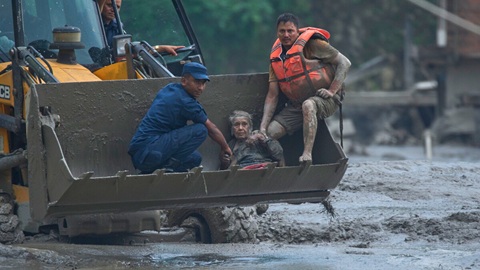
China has suspended a rescue operation in Tibet after authorities warned of renewed flooding in the aftermath of a devastating flash flood and mudslide that has left hundreds dead or missing along the China-Nepal border.
Chinese authorities ordered rescue teams to remain on standby after a lake formed by massive piles of debris began overflowing towards areas where emergency crews had been working. State broadcaster CCTV reported that the renewed threat made continued rescue operations too dangerous.
The decision came as emergency agencies in both China and Nepal struggled to reach communities devastated by the disaster, which struck on Wednesday following what experts identified as a glacier and rock collapse.
The resulting torrents of water, mud and debris swept through settlements, destroyed roads and bridges and caused extensive damage to infrastructure on both sides of the border.
The disaster has produced a rapidly changing humanitarian situation. Authorities in Nepal reported at least 469 deaths, while more than 1,400 people remained missing, although casualty figures continue to change as rescue teams reach previously isolated areas.
Among those missing are hundreds of foreign nationals, including tourists, pilgrims and workers who were in the Himalayan region when the flooding occurred.
In Tibet, the immediate concern has shifted from rescue operations to preventing another catastrophic flood.
A temporary lake has formed behind a huge accumulation of mud, rocks and other debris created by the landslide. Authorities fear that continued rainfall could cause the barrier to fail, releasing a new surge of water downstream.
Chinese engineers have been deployed to assess the situation and determine how the accumulated water can be safely released. Reuters reported that an eight-member engineering team was conducting aerial surveys and three-dimensional modelling of the newly formed lakes.
One of the lakes was estimated to be about 150 metres long and 40 to 50 metres deep, holding between 1.5 million and two million cubic metres of water.
Officials are considering excavating a drainage channel to gradually release the water and reduce pressure on the debris barrier. However, ongoing rainfall has made the terrain unstable and increased the danger to personnel working in the area.
The renewed threat has forced Chinese authorities to balance the urgent search for missing people with the need to protect rescue workers from another potentially deadly flood.
“All rescue teams have been ordered to stand by in place and wait for further instructions,” CCTV reported.
Meanwhile, rescue operations have continued on the Nepalese side, where thousands of security personnel have been mobilised to search for survivors and evacuate people trapped by the destruction.
Nepali Army helicopters have been deployed to reach isolated communities and transport survivors to safer locations. Rescue teams are also attempting to reach people trapped inside a tunnel at the Trishuli 3A hydropower project.
The scale of the destruction has made the operation particularly difficult. Roads and bridges have been washed away, while mud and debris have blocked access routes to affected communities.
The disaster is believed to have been triggered by the collapse of a glacier and underlying rock, sending an enormous volume of water, ice and debris into downstream valleys. Scientists have warned that the unstable Himalayan environment is increasingly vulnerable to such extreme events.
Experts have also warned that a second flood could occur if debris blocking waterways gives way.
The possibility has heightened anxiety among residents and rescue officials, particularly in communities downstream from the newly formed lakes.
The Chinese and Nepalese governments are therefore facing a dual challenge: rescuing those still missing while preventing another disaster that could worsen the already devastating death toll.
The tragedy has also renewed international concern over the vulnerability of Himalayan communities to glacier-related disasters. Climate scientists have warned that rising temperatures can contribute to glacier and permafrost instability, although establishing a direct cause-and-effect relationship for any individual disaster requires further scientific assessment.
For families still waiting for news of missing relatives, the suspension of rescue operations in Tibet represents another painful setback.
But authorities say the pause is necessary because sending rescue teams into an area threatened by a potential second flood could create additional casualties and make the emergency even more difficult to manage.
As engineers work to stabilise the newly formed lakes, authorities will continue monitoring rainfall, water levels and the condition of the debris barriers.
The immediate priority remains preventing another catastrophic surge while preserving the possibility of resuming the search for those still missing.
With hundreds of lives already lost and more than a thousand people still unaccounted for, the Himalayan disaster has become one of the region’s most serious recent natural catastrophes — and the threat of further flooding means the emergency is far from over.