

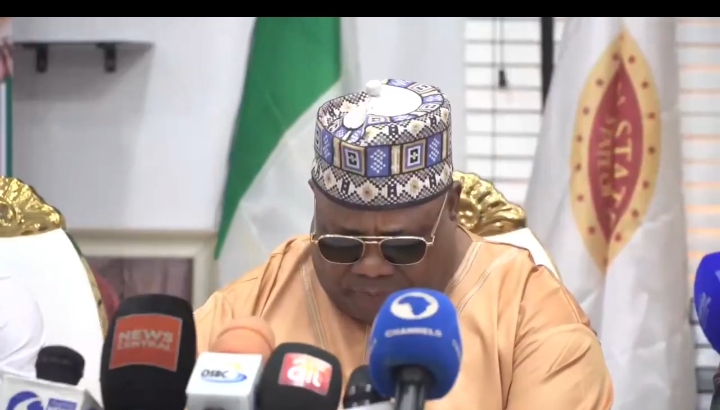
OSOGBO — Governor Ademola Adeleke of Osun State has reignited political debate across Nigeria after reaffirming his endorsement of President Bola Ahmed Tinubu for a second term in the 2027 presidential election, barely hours after securing another four-year mandate in the Osun governorship election.
Adeleke made the declaration on Sunday, August 16, 2026, during a press conference following the Independent National Electoral Commission’s declaration of his victory in Saturday’s governorship election.
The governor, who described President Tinubu as a “son of Osun State,” thanked the President for what he characterised as support for a free and fair election in the state.
“At this point, I must deeply appreciate Mr. President, His Excellency Senator Bola Ahmed Tinubu, for his strong support for a free and fair election,” Adeleke said.
He subsequently reaffirmed his earlier endorsement of Tinubu, stating that the President deserved another term in office.
The declaration has assumed particular political significance because Adeleke contested the Osun governorship election under the Accord Party, while Tinubu remains the presidential standard-bearer of the All Progressives Congress (APC).
From Opposition Figure to Tinubu Supporter
Adeleke’s political positioning has evolved considerably in the months leading to the 2027 presidential contest.
In May, the governor explained his support for Tinubu as a “moral and development driven action” which, according to him, was in the best interest of Osun State and the Yoruba people.
He later moved from the Peoples Democratic Party to Accord and continued to maintain his support for Tinubu.
Accord subsequently joined Adeleke in adopting Tinubu for the 2027 presidential election, with party leaders arguing that the administration should be allowed to complete major infrastructure projects already underway.
The latest endorsement therefore appears less like an isolated post-election statement and more like a continuation of a political position Adeleke has deliberately maintained.
The Timing Raises Political Questions
The timing of the declaration, however, is certain to attract attention.
Adeleke made the statement immediately after receiving a fresh mandate from Osun voters. His victory came in an election in which his closest challenger was the APC candidate, Bola Oyebamiji.
According to reports on the final outcome, Adeleke won 19 local government areas, while Oyebamiji secured 11. The ADC candidate, Najeem Salaam, finished third with 17,180 votes.
The political irony is therefore difficult to ignore: a governor who has just defeated the candidate of Tinubu’s APC in his own state is simultaneously calling for the re-election of the APC-controlled Federal Government.
That distinction is likely to become an important subject of political analysis as preparations for 2027 intensify.
What Does Adeleke’s Endorsement Mean for Osun Voters?
For Adeleke’s supporters, the endorsement may be viewed as political pragmatism.
The governor has argued that Tinubu’s administration has supported projects and development initiatives affecting Osun and the wider South-West. His position is that maintaining a working relationship with the Federal Government could benefit the state.
Critics, however, may interpret the development differently.
They could ask whether the political alliance reflects the aspirations of the voters who supported Adeleke against the APC candidate in Saturday’s election.
That question is particularly relevant because the Osun election itself became a referendum of sorts on several issues, including the strength of the APC in the state, internal party divisions and voters’ attitudes towards the wider political environment.
One recent analysis attributed the APC’s defeat partly to internal disagreements and voter dissatisfaction with the country’s economic situation, alongside Adeleke’s grassroots political structure.
Youths and the Politics of Disillusionment
The development is also likely to generate strong reactions among young Nigerians who have increasingly demanded political alternatives and greater accountability from elected officials.
For sections of the youth population, the political realignment may reinforce a familiar perception that politicians frequently change alliances once elections are over.
This is where the criticism that “Adeleke endorses Tinubu for a second term of loans, hunger and insecurity” enters the political conversation.
That description, however, is a political opinion rather than an established fact. A responsible assessment should separate the governor’s actual endorsement from claims about the causes or consequences of Nigeria’s economic and security problems.
Nevertheless, the concerns behind such criticism are real political issues. The electorate will ultimately judge the Tinubu administration on matters including living costs, employment, purchasing power, security, public infrastructure and the broader quality of governance.
“Agreement Is Agreement”
The Federal Government has already welcomed Adeleke’s declaration.
Minister of Aviation and Aerospace Development Festus Keyamo thanked the governor for publicly reaffirming his support for Tinubu’s 2027 re-election bid.
Keyamo’s response was summarised in the phrase: “Agreement is agreement.”
The response suggests that Adeleke’s endorsement is being viewed within the Tinubu camp as a politically significant commitment rather than merely a ceremonial congratulatory statement.
It also reinforces the growing political realignment ahead of 2027, particularly in the South-West.
A New Political Equation
The emerging political equation is particularly interesting.
Adeleke has secured a new mandate in Osun under Accord, while supporting a president who belongs to another political party.
That creates a situation in which the governor’s immediate political interests at the state level and his presidential preference at the national level are not necessarily aligned along conventional party lines.
It also demonstrates how Nigeria’s 2027 political contest may increasingly be shaped by personalities, regional calculations, political agreements and individual interests rather than strictly by party ideology.
The Bigger 2027 Question
The bigger question is whether Adeleke’s endorsement can translate into actual electoral support for Tinubu in Osun State.
An endorsement by a governor does not automatically translate into the votes of millions of citizens.
Osun voters remain sovereign actors, and Saturday’s election itself demonstrated that voters can distinguish between candidates, parties and levels of government.
Indeed, the fact that the APC lost the governorship election while Adeleke simultaneously supports Tinubu provides an early indication that political endorsements and electoral behaviour should not necessarily be treated as synonymous.
The 2027 presidential election will ultimately be decided by voters across Nigeria.
Political Calculus or Principle?
Adeleke’s supporters may describe his position as strategic engagement with the Federal Government, while his critics may portray it as political compromise.
The governor himself has framed his decision around development, morality, regional interest and appreciation for Tinubu’s role in Osun’s affairs.
The opposing interpretation will likely focus on the contradiction between supporting a president whose party was defeated in the Osun governorship election and the expectations of voters seeking political change.
Both interpretations will form part of the political debate going into 2027.
The Masses Will Have the Final Say
Ultimately, the significance of Adeleke’s endorsement will not be determined by political speeches, party meetings or elite negotiations.
It will be determined by the electorate.
The Nigerian voter will have the opportunity to assess the government’s record and decide whether the country’s current direction deserves continuation or change.
For young Nigerians who feel exhausted by political mobilisation, rising economic pressure and repeated promises of transformation, Adeleke’s declaration may therefore be seen either as pragmatic politics or another reminder of the distance between political elites and ordinary citizens.
The real test will come at the ballot box.
**Adeleke has spoken. Tinubu has gained another influential supporter. But the final endorsement belongs to the Nigerian people.**


