

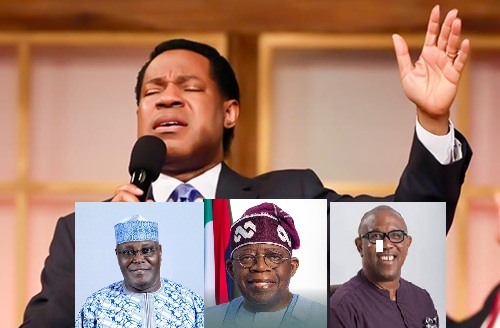
A video from a February 2023 religious gathering hosted by popular televangelist Chris Oyakhilome has resurfaced online, sparking renewed speculation about Nigeria’s 2027 presidential election despite originating from events leading up to the 2023 polls.
The footage, which has recently been circulated alongside graphics and captions referencing the 2027 election, features remarks made during a Loveworld programme in which three unnamed presidential contenders were described symbolically. In the video, one candidate was characterized as a “jackal” who would be cut off, another as someone who would allegedly bring hardship to the country, and a third as a biblical-type figure who was reluctant or afraid to win.
At the time the comments were made in 2023, many viewers interpreted the descriptions as references to the three leading presidential candidates in the race: Bola Ahmed Tinubu, Atiku Abubakar, and Peter Obi.
Following the election, which Tinubu won with approximately 37 percent of the total votes cast, supporters and critics of various candidates continued to debate the meaning and accuracy of the statements. The election itself generated significant controversy, with opposition parties raising concerns about the conduct of the polls and challenging aspects of the results through legal channels.
Now, more than three years later, the same video has resurfaced as political discussions intensify ahead of the 2027 general election.
Social media users have been sharing the clip with new captions suggesting that it contains predictions about the forthcoming election. Some posts imply that the remarks are a fresh prophecy concerning current political developments, while others attempt to link the symbolic descriptions to emerging political alignments and potential candidates.
However, fact-checkers and political observers have pointed out that the footage is not new and was recorded before the 2023 election. They note that there is no evidence that Oyakhilome has issued a new prophecy concerning the 2027 contest based on the circulating video.
Analysts say the repackaging of old political and religious content is becoming increasingly common as Nigeria’s political environment begins to heat up ahead of another election cycle.
Supporters of prophetic interpretations argue that such messages can provide spiritual insight into national affairs. Critics, however, caution against relying on prophecies, predictions, or symbolic statements when making political decisions.
Many observers have urged citizens to focus on issues such as governance, economic performance, security, education, healthcare, and electoral participation rather than speculative interpretations of past statements.
Political commentators also warn that misleading presentations of old content can distort public understanding and contribute to misinformation during politically sensitive periods.
With political parties preparing for primaries and coalition discussions gaining momentum, attention is gradually shifting toward candidate emergence, voter mobilization, and campaign strategies.
As the 2027 election approaches, analysts emphasize that democratic outcomes will ultimately be determined by voters, electoral institutions, and the political process rather than by social media speculation surrounding past prophecies.
For now, the resurfaced video serves as a reminder of the powerful role that religion, politics, and social media continue to play in shaping public discourse in Nigeria. Whether viewed as a spiritual message or a historical artifact of the 2023 election season, the footage has once again found relevance in the country’s evolving political conversation.


