

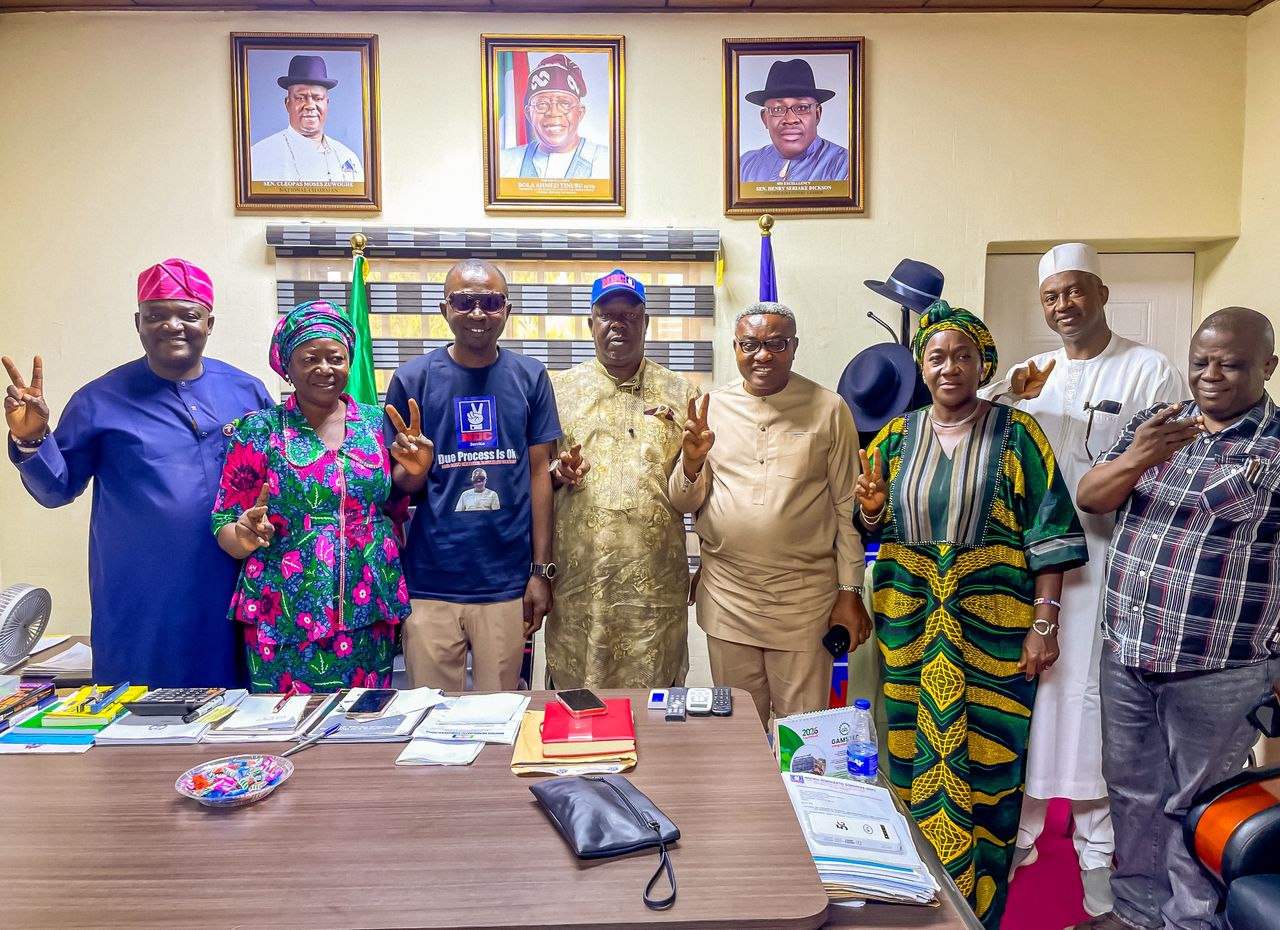
In what political observers described as a strategic convergence of grassroots democratic forces and reform-driven Political Action Group, a delegation of the Coalition for the Protection of Democracy (COPDEM) held an extensive consultative meeting with the leadership of the Nigeria Democratic Congress (NDC) at the party’s National Secretariat.
The high-level engagement centered on the urgent need to strengthen the party’s national mobilisation framework ahead of the evolving political realities in Nigeria, while also addressing concerns relating to inclusion, regional political balance, youth participation, diaspora coordination, and support mechanisms for aspirants facing socio-economic hardship due to insecurity and terrorism in parts of Northern Nigeria and the Middle-Belt.
The COPDEM delegation was led by Prof. Emeka Ene, Director General of the COPDEM Aspirants Forum, alongside Mr. Akor Christian Oche, widely known as “Due Process,” who currently serves as the National Youth Leader of COPDEM and represents the COPDEM National Secretariat. Other members of the delegation also participated actively during the interactive session with the National Chairman of NDC, Senator Cleopas Moses Zuwoghe.
National Mobilisation Framework:
At the heart of the discussions was the need for the NDC to develop a robust and decentralised national mobilisation structure capable of penetrating communities at ward, local government, state, and diaspora levels.
COPDEM emphasized that modern political engagement can no longer rely solely on elite-driven campaigns concentrated in urban centers, but must instead evolve into a people-oriented movement rooted in grassroots participation, ideological clarity, and sustained community engagement.
The delegation reportedly proposed the establishment of coordinated mobilisation directorates across all geopolitical zones, with special focus on youth volunteers, women inclusion networks, professionals, artisans, students, and rural political advocacy teams.
The group further stressed the importance of political education and voter orientation, arguing that the success of any reform-based political movement depends largely on continuous citizen engagement rather than seasonal electioneering.
According to insiders at the meeting, discussions also touched on digital mobilisation strategies, data-driven membership recruitment, policy communication structures, and issue-based campaigns aimed at restoring public trust in democratic participation.
Diaspora Coordination and Grassroots Engagement:
Another major aspect of the deliberations focused on the role of Nigerians in the diaspora in supporting democratic reforms and grassroots political participation back home.
COPDEM proposed the development of a structured diaspora coordination mechanism that would allow Nigerians abroad to contribute strategically to civic enlightenment, policy advocacy, fundraising, humanitarian interventions, and grassroots mobilisation projects in their various communities.
The delegation argued that many Nigerians living abroad possess valuable expertise, international exposure, and economic resources that could strengthen democratic institutions and political participation if properly integrated into national political development.
The proposed framework seeks to bridge the gap between diaspora enthusiasm and local community realities by creating transparent channels of collaboration between overseas supporters and grassroots organisers across the country.
The discussions also highlighted the importance of technology-driven political communication capable of connecting rural communities with global democratic networks supportive of a “New Nigeria” agenda.
Concerns Over Insecurity and Economic Displacement:
One of the most emotional moments during the meeting reportedly came when discussions shifted to the plight of aspirants and political stakeholders from parts of Northern Nigeria and the Middle-Belt who have suffered economic setbacks due to prolonged insecurity, displacement, and terrorist activities.
The delegation noted that several promising political actors, youth leaders, entrepreneurs, and community organisers in affected regions have lost businesses, properties, livelihoods, and political structures as a result of recurring attacks linked to safe-haven terrorism and violent conflicts.
COPDEM therefore advocated for strategic concessions, institutional support systems, and inclusive participation measures that would ensure that capable aspirants from affected areas are not unfairly excluded from the democratic process due to circumstances beyond their control.
The group maintained that genuine national inclusion must take into account the uneven social and economic realities confronting different regions of the country, especially communities battling insecurity and humanitarian crises.
Political analysts believe the proposal reflects growing concerns over the long-term impact of insecurity on democratic participation, political representation, and economic stability in vulnerable regions.
NDC Leadership Responds:
Responding after the exhaustive engagement, Senator Cleopas Moses Zuwoghe commended COPDEM for what he described as a proactive and visionary mobilisation effort aimed at expanding the party’s national reach and deepening citizen participation.
He praised the organisation’s commitment to grassroots recruitment and issue-based political advocacy, noting that the recommendations presented align with the broader aspirations of Nigerians seeking a more inclusive, accountable, and development-oriented political alternative.
The NDC National Chairman reiterated the unwavering commitment of the party’s National Working Committee (NWC) toward building what he described as “the New Nigeria that is Possible,” anchored on democratic reforms, social justice, economic empowerment, transparency, and national unity.
According to him, the observations and recommendations submitted by COPDEM would be carefully reviewed by the party leadership as part of broader institutional consultations currently ongoing within the party.
He further assured the delegation that another conclusive meeting would be convened immediately after the ongoing aspirants’ screening exercise to enable both parties harmonize strategies and commence practical implementation of agreed frameworks.
Emerging Political Synergy:
The engagement is already being interpreted in some political circles as a sign of increasing collaboration between reform-oriented civic movements and emerging opposition political structures seeking to reposition themselves ahead of future electoral contests.
Observers say the emphasis on inclusion, youth mobilisation, diaspora engagement, and grassroots-driven political participation signals a gradual shift away from conventional personality-based politics toward more structured issue-based political organising.
For many participants, the meeting represented more than a routine courtesy visit; it was viewed as an attempt to lay the foundation for a broader democratic coalition capable of addressing governance failures, insecurity, economic hardship, and citizen disillusionment across the country.
As Nigeria continues to navigate economic uncertainty, insecurity, and growing public demand for political reforms, stakeholders believe that sustained engagements between civic movements like COPDEM and political institutions such as the Nigeria Democratic Congress may shape the direction of grassroots democratic participation in the years ahead.


