

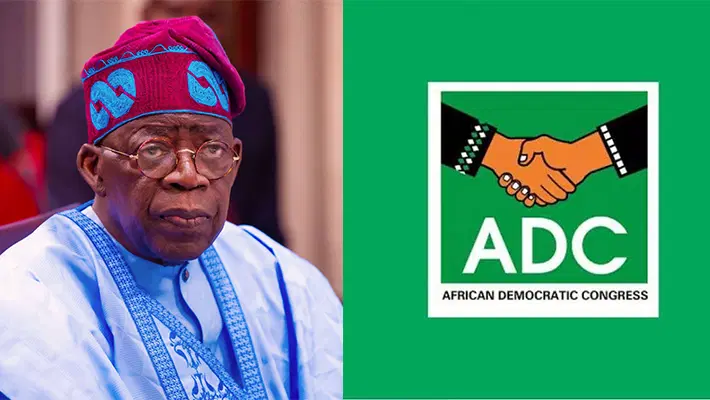
A fresh political storm has erupted in Nigeria’s capital as lawmakers of the African Democratic Congress (ADC) publicly accused Bola Tinubu of meddling in the party’s internal affairs, raising concerns over the state of Nigeria’s democracy ahead of the 2027 general elections.
At a heated press conference held on April 21, 2026, in Abuja, members of the ADC National Legislators Forum, led by its chairman David Mark, alleged that the Presidency, alongside top government officials and institutions, is attempting to influence the party’s ongoing leadership dispute, which is currently before the courts.
The forum specifically named Femi Gbajabiamila and the Independent National Electoral Commission (INEC) as parties allegedly complicit in what they described as undue interference. According to the lawmakers, recent political developments suggest a coordinated effort to destabilize the ADC from within.
Former lawmaker Nnenna Elendu-Ukeje, one of the prominent voices at the briefing, pointed to remarks attributed to President Tinubu concerning the party’s recent convention, which she argued were inappropriate and indicative of external influence. Similarly, Senator Dino Melaye alleged that comments credited to Gbajabiamila advising political actors to “scatter” the ADC from within further reinforced suspicions of interference.
“The actions and statements we are witnessing are not only troubling but dangerous for the future of multi-party democracy in Nigeria,” the forum declared in a joint statement. “No ruling government should seek to weaken opposition structures through indirect or direct means.”
Beyond allegations of political interference, the lawmakers also raised broader concerns about the state of the nation. They cited rising insecurity across various regions and growing national debt figures—reportedly nearing ₦150 trillion—as evidence of governance challenges under the current administration. According to them, such issues should be the priority of government rather than involvement in party disputes.
The accusations have, however, been strongly rejected by members of the ruling All Progressives Congress (APC), who described the claims as “reckless” and politically motivated. Party loyalists argue that the ADC’s internal crisis is self-inflicted and should not be blamed on the Presidency or federal institutions.
Political analysts note that the controversy underscores the intensifying rivalry between Nigeria’s ruling party and opposition groups as the 2027 elections draw closer. The ADC, which has recently witnessed an influx of prominent political figures and shifting alliances, is increasingly positioning itself as a key opposition platform.
Observers warn that allegations of interference—whether proven or not—could erode public confidence in democratic institutions, particularly the judiciary and electoral bodies. With ongoing court cases surrounding the ADC’s leadership dispute, concerns about judicial independence have also come to the forefront.
As the political temperature rises, Nigerians are watching closely to see how the situation unfolds. Whether the claims lead to formal investigations or remain part of the broader political rhetoric, the episode has once again highlighted the fragile balance between power, opposition, and democratic integrity in Africa’s largest democracy.
For now, the ADC lawmakers’ message is clear: any perceived encroachment on party autonomy, they insist, must be resisted to preserve the credibility of Nigeria’s democratic process.


