

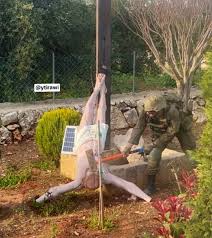
Widespread anger and condemnation have erupted across the Middle East and beyond following the circulation of a controversial image allegedly showing an Israeli soldier vandalising a statue of Jesus Christ in southern Lebanon.
The photograph, which rapidly gained traction on social media, appears to depict a uniformed soldier believed to be affiliated with the Israel Defense Forces striking a statue representing Jesus Christ. The incident is said to have occurred in a Christian-majority area of Lebanon, a nation known for its delicate religious balance and historic Christian communities.
The image has triggered a wave of outrage among religious leaders, human rights advocates, and political figures, many of whom have described the act as deeply offensive and provocative. Critics argue that the alleged destruction of a revered religious symbol risks inflaming sectarian tensions in an already volatile region.
Local church authorities in Lebanon have called for an immediate investigation into the incident, urging international bodies to hold those responsible accountable. “This is not merely an act of vandalism; it is an assault on faith and human dignity,” a senior cleric stated, reflecting the growing frustration among Christian communities.
While the authenticity of the image and the exact circumstances surrounding the incident remain under scrutiny, the backlash has been swift. Social media platforms have been flooded with reactions ranging from grief to anger, with many users demanding an official response from Israeli authorities.
As of the time of reporting, the Israeli government has not issued a detailed statement addressing the specific allegations. However, past incidents involving misconduct by military personnel have often been met with internal investigations by the Israeli military establishment.
Analysts warn that such incidents—whether isolated or systemic—carry significant geopolitical consequences. Lebanon, already grappling with economic challenges and political instability, remains highly sensitive to actions perceived as violations of its sovereignty or religious identity.
The situation also raises broader concerns about the protection of religious heritage sites in conflict zones. International conventions, including those backed by UNESCO, emphasise the safeguarding of cultural and religious monuments, even during times of war.
Observers note that the symbolic nature of the alleged act could amplify its impact far beyond the immediate location. “When religious icons are targeted, the reaction is rarely confined to one country,” said a regional affairs expert. “It resonates across continents and communities.”
Calls for calm have accompanied the outrage, with some leaders urging restraint until the facts are fully established. Nonetheless, the image has already left a deep impression, reigniting debates about military conduct, religious tolerance, and accountability in conflict zones.
As investigations continue, the international community will be watching closely to see whether the incident is addressed transparently—and whether it will further strain relations in an already fragile region.


