

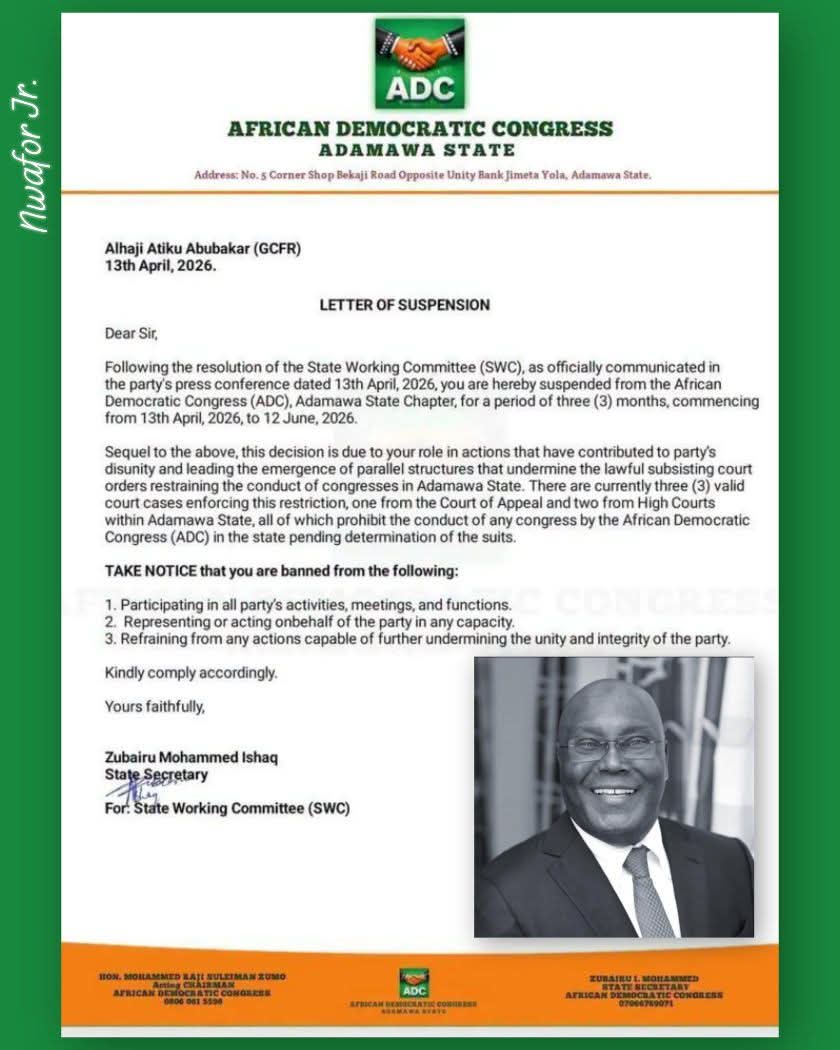
Yola, Adamawa State — The purported suspension of former Vice President, Atiku Abubakar, by the Adamawa State chapter of the African Democratic Congress (ADC) has triggered widespread controversy, raising critical legal and political questions within Nigeria’s opposition space. The development, conveyed through a letter dated April 13, 2026, was signed by the party’s State Secretary, Zubairu Mohammed Ishaq, who stated that the decision followed resolutions reached by the State Working Committee (SWC) during a press briefing held the same day.
According to the document, Atiku was handed a three-month suspension over allegations of anti-party activities, including actions said to have contributed to internal disunity, the creation of parallel party structures, and the undermining of subsisting court orders affecting the party’s operations in Adamawa State. The letter further referenced three ongoing legal cases, including one at the Court of Appeal, which reportedly restrain the conduct of party congresses in the state pending judicial determination, pointing to deepening factional tensions within the party.
Despite the gravity of the announcement, the move has raised significant questions regarding its legitimacy, particularly given that Atiku Abubakar is widely recognized as a leading figure within the Peoples Democratic Party (PDP), with no broadly acknowledged defection to the ADC. This has fueled speculation that the action may either be symbolic, faction-driven, or linked to ongoing behind-the-scenes political realignments ahead of the 2027 general elections.
Political analysts suggest that the situation reflects deeper structural struggles within the African Democratic Congress, where competing interests may be vying for control in strategic northern states. The mention of parallel structures in particular indicates the possibility of rival factions operating within the same party framework, a scenario that has historically weakened party cohesion and electoral strength in Nigeria’s political environment.
The timing of the development is also significant, as opposition parties and key political actors continue to explore coalition pathways in preparation for 2027. The ADC has increasingly been mentioned as a potential platform for broader alliances, and any internal crisis—especially one involving a high-profile figure like Atiku Abubakar—could complicate such efforts or signal resistance to external influence within the party.
As of press time, there has been no official response from Atiku, while the national leadership of the African Democratic Congress has yet to confirm or repudiate the suspension. The absence of clarification from key stakeholders leaves the development shrouded in uncertainty, with observers awaiting further statements to determine its authenticity and potential implications.
For now, what appears to be a routine disciplinary measure has evolved into a politically charged issue, underscoring the fragile nature of party unity and the high-stakes maneuvering already underway ahead of Nigeria’s next electoral cycle.
Update;
ADC Crisis Deepens: Atiku Suspension Notice Lacks Standing — Sources
Fresh details have emerged indicating that the purported suspension notice against former Vice President Atiku Abubakar was issued by a faction of the African Democratic Congress (ADC) led by Nafiu Bala Gombe, raising serious questions about its legal validity.
Party insiders argue that the faction lacks the locus standi to discipline Atiku or any recognized member of the party, thereby rendering the move largely symbolic and politically motivated.
The development comes amid escalating internal divisions within the ADC, particularly in Adamawa State, where the party is now fragmented into three rival factions. Each bloc is reportedly vying for legitimacy and influence in opposition to the National Working Committee (NWC) aligned with former Senate President David Mark.
Observers warn that the deepening factional crisis could significantly undermine the ADC’s cohesion ahead of the 2027 general elections, as competing interests continue to clash over leadership and strategic direction.


