

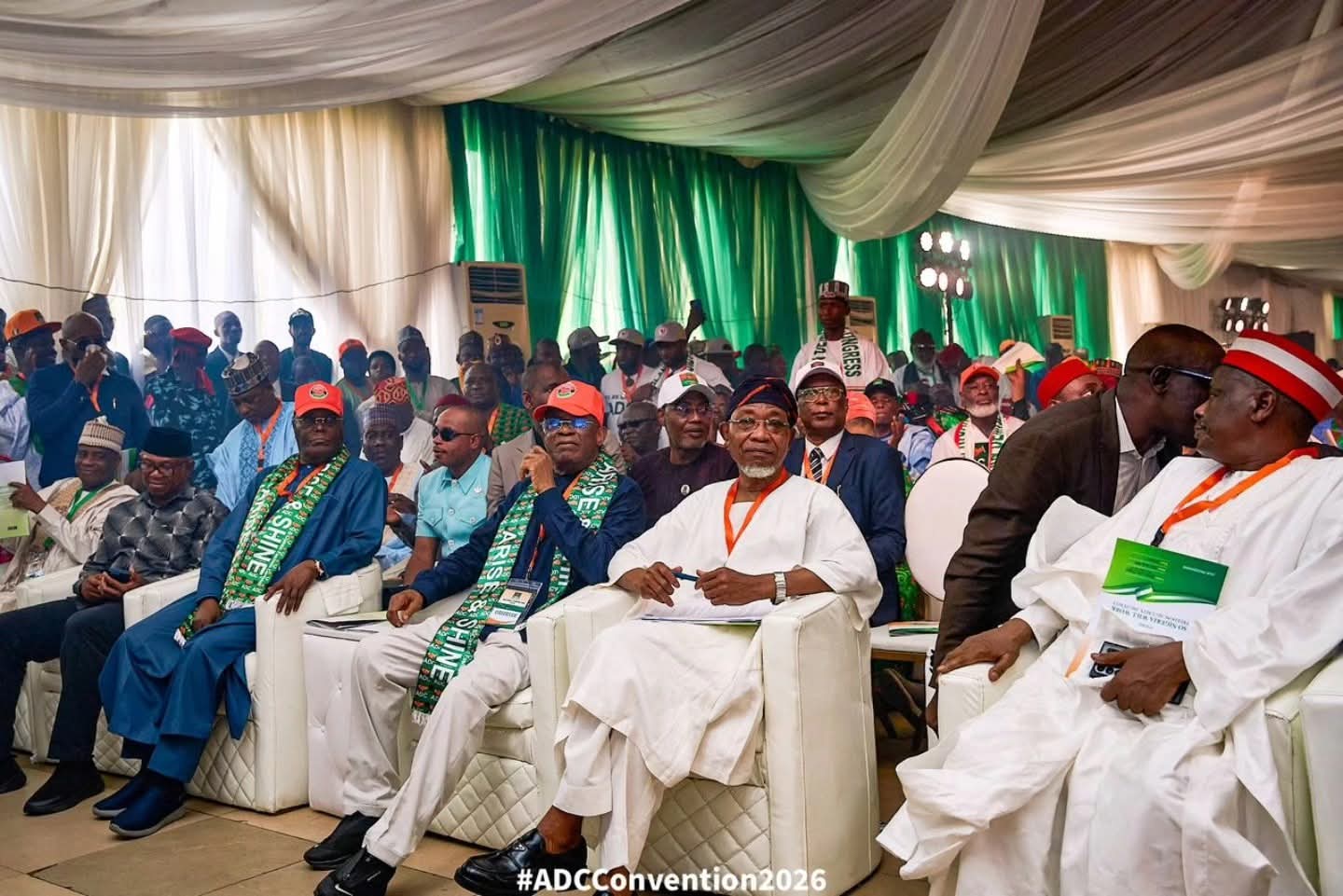
Abuja — The internal crisis rocking the African Democratic Congress (ADC) has entered a boiling phase, with competing factions intensifying their struggle for control amid looming court rulings and early permutations for Nigeria’s 2027 general elections.
At stake is not only the future of the party but also the broader configuration of opposition politics, as key political actors weigh their options in a rapidly shifting landscape.
Three Factions, Divergent Interests
The faction led by former Senate President David Mark has emerged as a central force, drawing backing from influential opposition figures and defectors. Widely viewed as a potential “coalition platform,” this bloc is believed to have the tacit support of former Vice President Atiku Abubakar, alongside growing interest from supporters of Peter Obi, the Labour Party’s 2023 presidential candidate, though he has yet to formally align.
In opposition stands the faction linked to Nafiu Bala Gombe, which claims legitimacy as the party’s original structure. This group has resisted what it describes as an attempted takeover by external political heavyweights, insisting on preserving the ADC’s internal integrity.
A third bloc, led by former presidential candidate Dumebi Kachikwu, has positioned itself as a reformist alternative. While lacking elite political backing, it has attracted support among younger members and reform advocates pushing for transparency and internal accountability.
INEC, Courts Stall Party Activities
The crisis has drawn in the Independent National Electoral Commission (INEC), which has reportedly withheld recognition of certain leadership claims. This has effectively paralysed critical party functions, including congresses and preparations for future primaries.
Legal battles across multiple courts are now expected to determine the legitimate leadership, a decision that will ultimately define the party’s electoral viability heading into 2027.
2027 Calculations Begin to Take Shape
As the legal and political drama unfolds, attention is shifting toward how different outcomes could reshape the presidential race, particularly in relation to incumbent President Bola Ahmed Tinubu.
Scenario One: Coalition Breakthrough
Should the Mark-led faction secure control, the ADC could evolve into a formidable coalition platform. A joint ticket featuring Atiku Abubakar and Peter Obi is widely speculated, with possible configurations including:
Atiku Abubakar as presidential candidate with Peter Obi as running mate
Peter Obi leading the ticket with northern backing aligned to Mark’s network
Such an alliance could significantly consolidate opposition votes across regions.
Scenario Two: Fragmentation Persists
If control remains with internal factions, the ADC may struggle to attract broader alliances. In that case:
Atiku Abubakar may remain within or return to the Peoples Democratic Party (PDP)
Peter Obi could continue under the Labour Party Nigeria
This would likely produce multiple opposition candidates, fragmenting votes and indirectly strengthening the ruling party’s position.
Scenario Three: Legal Gridlock
A prolonged legal impasse could leave the ADC sidelined entirely if it fails to meet key electoral deadlines. Under this scenario:
The party risks exclusion from the 2027 elections
Coalition efforts may shift toward forming an entirely new political platform
A Defining Test for Nigeria’s Opposition
Analysts view the ADC crisis as a critical test of whether Nigeria’s opposition can overcome entrenched divisions to present a unified front. The outcome will not only determine the party’s fate but could also shape the trajectory of the 2027 presidential contest.
With court rulings pending and political alignments evolving, the months ahead are set to be decisive. For now, the ADC remains locked in an internal battle—one with far-reaching implications for Nigeria’s democratic landscape.


