

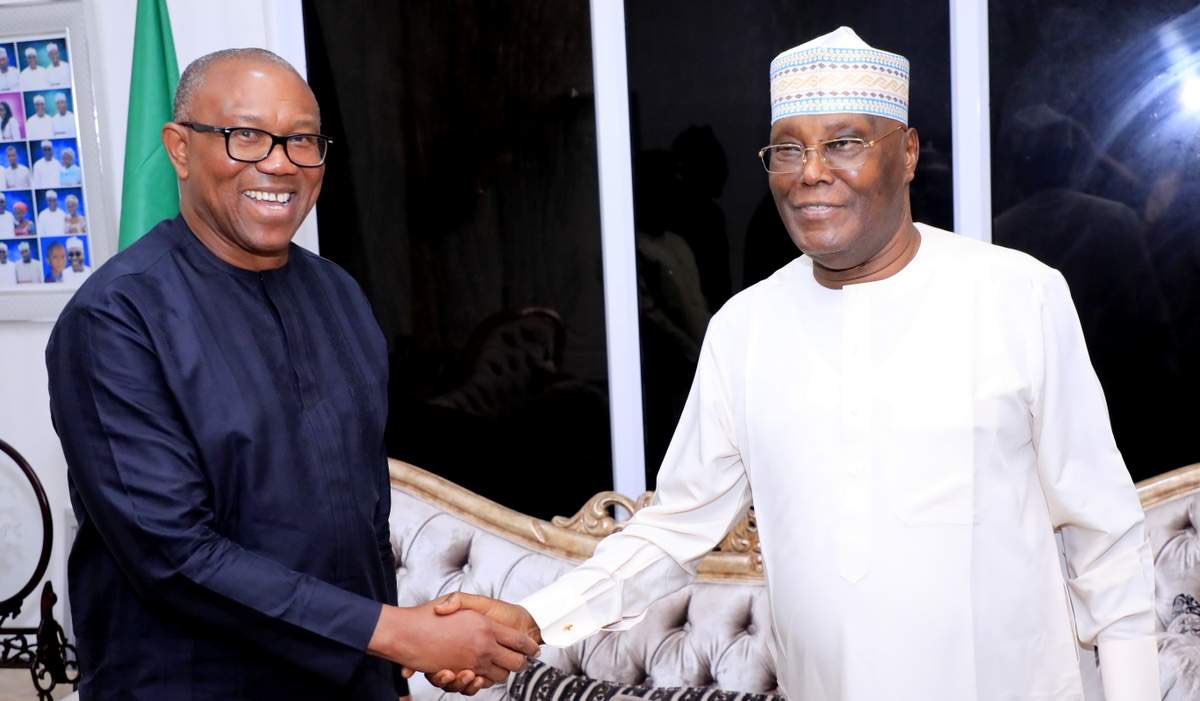
ABUJA — Nigeria’s political landscape ahead of the 2027 general elections took a dramatic turn on Thursday as former Vice President Atiku Abubakar indicated he would withdraw from the presidential race if Peter Obi secures the presidential ticket of the African Democratic Congress (ADC).
The statement, which has quickly gained traction across political circles, signals a potential shift toward opposition unity as key actors begin early positioning for what is expected to be a fiercely contested election.
Atiku, who served as Nigeria’s vice president between 1999 and 2007, has been one of the country’s most consistent presidential aspirants since the return to democratic rule. His willingness to step aside—albeit conditionally—marks a notable departure from his previous campaigns and suggests growing recognition of the need for coalition-building among opposition parties.
Political analysts say the remark reflects increasing pressure on opposition leaders to avoid fragmentation, which has historically weakened their chances against incumbents. “This is a strategic calculation,” a political analyst in Abuja noted. “The opposition understands that without unity, it risks repeating past electoral outcomes.”
The inclusion of Peter Obi in Atiku’s statement underscores Obi’s continued influence in Nigeria’s political arena. Obi, who ran under the Labour Party in the 2023 presidential election, built a strong support base among young voters and urban populations, earning him significant national visibility and political capital.
Although Obi has not officially declared any intention to run under the ADC platform, recent discussions around coalition politics have linked his name with broader opposition realignment efforts. The ADC, in particular, has emerged as a potential rallying platform for disparate opposition figures seeking to consolidate their strength ahead of 2027.
Sources familiar with ongoing political consultations suggest that talks are underway among several opposition stakeholders to form a united front capable of challenging the ruling party’s dominance. Atiku’s statement is widely interpreted as part of these behind-the-scenes negotiations.
Observers note that such a move, if realized, could significantly reshape Nigeria’s electoral dynamics. A unified ticket featuring major opposition figures could potentially mobilize a broader voter base and reduce the risk of vote-splitting—a key factor that has influenced previous election outcomes.
However, questions remain about the feasibility of such an alliance. Political interests, ideological differences, and party structures may pose challenges to any meaningful coalition. Additionally, the process of securing a party ticket within the ADC could itself become a contentious issue, given the number of high-profile figures reportedly interested in the platform.
Despite these uncertainties, Atiku’s comments have injected fresh momentum into political discourse, prompting reactions from party loyalists, civil society groups, and the general public.
For many Nigerians, the prospect of opposition unity represents a possible turning point in the country’s democratic evolution. Yet, as analysts caution, translating political statements into concrete alliances will require compromise, trust, and sustained negotiation among key players.
As the countdown to 2027 gradually begins, all eyes will remain on how these early signals of cooperation evolve—and whether they can ultimately reshape the balance of power in Africa’s largest democracy.


